Article Overview
What comes to your mind when you hear AI in banking?
For most banking leaders, it’s customer-facing tools like chatbots, fraud detection, personalized offers. That makes sense. After all, every bank wants to be more customer centric.
But there’s another side to AI. One that’s less visible and just as critical. A side that helps your internal teams do work faster and better, and helps your bank get from A to Z without getting stuck in B.
In this article, we’ll look at AI’s role in two areas:
- The customer-facing capabilities everyone talks about
- The strategy execution power that works behind the scenes
AI implementations impacting your clients directly
Fraud detection and prevention
By far, this is one of AI’s most proven plays in banking. Modern systems analyse transaction patterns, devices, and behaviour in real time to prevent malicious actions. Modern machine learning evolves with every data point, catching what humans often miss.
Why it matters:
- Real-time detection of suspicious activity
- Fewer false positives (less frustration for customers)
- Stronger defence against phishing, ID theft, and payment fraud
Example: From 2024 to 2025 Revolut’s (UK) AI-based fraud detection system has prevented scams totalling over €550 million and has decreased by 30% fraud losses from card scams. (Source: Revolut.com)
Customer service and virtual assistants
AI-powered assistants now handle everything from basic questions to bill payments and loan support, with 24/7 availability and human-like communication. Chat bots no longer feel like a limited script. They now can reason, solve real problems and assist with empathy and human-like speech.
Why this matters:
- Answer balance and transaction queries 24/7
- Assist with payments and transfers
- Support loan applications and offer financial advice
- Recommend relevant products in real time
- Provide information about terms, conditions, procedures and more
- Frees up time from customer service representatives to focus on complex communications and tasks
Example: Bank of America’s (US) virtual assistant Erica has handled over 2.5 billion customer interactions so far, dramatically improving self-service at scale. (Source: bankofamerica.com)
Credit risk assessment and scoring
By analysing more data such as spending habits, employment history, digital behaviour and more, banks can assess creditworthiness more accurately, more fairly, and much faster.
Why this matters:
- Smarter default risk predictions
- Faster loan decisions
- Access to credit for more people
- Less manual effort for teams
Example: ING (Netherlands) uses AI to offer instant, personalized loans by analysing real-time transactional data. This AI implementation reduces lending decisions from days to minutes. (Source: ing.com)
Personalized banking services
Most people struggle with finance management. Hiring an expert is costly but now AI can give personalized advice based on real behaviour and goals. Saves time, efforts, minimizes risks, and costs for everyone involved.
Why this matters:
- Quick and tailored investments advised by AI
- More accessible budgeting tools and spend insights
- Personalized product offers
- Smart nudges toward financial goals and actions
Example: DBS Bank (Singapore) delivers over 30 million hyper-personalized nudges per month based on 15,000 data points per customer. This AI automation massively increases customer engagement and revenue through upsell. (source: dsb.com)
Algorithmic trading and investment management
AI-driven trading platforms process vast datasets in milliseconds. This allows for banking platforms to spot patterns and execute trades with great precision.
Why this matters:
- High-frequency trading
- Real-time market trend forecasting
- Automated portfolio rebalancing
- Built-in risk controls
Example: Goldman Sachs' AI-powered trading algorithms have increased trading efficiency by 40%, enabling smarter, faster decisions across markets. (Source: redresscompliance.com)
Regulatory compliance and anti-money laundering (AML)
Compliance is complex. Especially in the finance industry. AI simplifies it. These systems detect anomalies, flag risks, and automate KYC and AML workflows, cutting both cost and compliance gaps.
Why this matters:
- Auto-generated regulatory reports
- Improved AML detection
- Streamlined KYC checks
- Fewer errors, lower costs
Example: HSBC’s (UK) AI-enhanced compliance systems have strengthened AML processes while enabling a 15% increase in customer card spend through smarter oversight. (Source: ffnews.com)
Robotic Process Automation (RPA)
Repetitive tasks and processes? Let AI handle them. RPA automates manual, rule-based work so your teams can focus on strategic execution. No wonder why 80% of finance leaders show willingness to adopt it.
Why this matters:
- Data entry and document handling
- Account reconciliation
- Loan processing
- Customer onboarding
- M&A processes
Example: Wells Fargo (US) has integrated AI-driven automation of document processing and verification, reducing loan approval times from 5 days to just 10 minutes. (Source: redresscompliance.com)
AI implementations for your strategy execution
Customer-facing AI gets all the attention, but the harder work in banking happens behind the scenes where you have to align thousands of people, keep initiatives on track, and ensure the strategy you present to the board is actually the strategy executed on the ground.
This is the real advantage AI brings to banks today:
an operating system that keeps your strategy alive, aligned, and accelerating week after week.
Below are the core ways AI shifts strategy execution from manual lift to automatic momentum.
AI for goal setting and strategic alignment
Companies in the finance sector don’t struggle with strategy. Strategy is usually clear and well-understood by the C-level. The real challenge comes with turning it into daily work and getting everyone aligned to it.
Half of managers can’t name the top five priorities. Most employees can’t name even one.
AI agents fix this by doing the hard work for you:
- Turn strategy documents, board decks, and priorities into draft enterprise goals
- Auto-align team goals across the entire organization
- Spot misalignment or duplicated work the moment it appears
- Recommend goals based on your business context, not generic templates
As a result, leaders no longer spend days chasing clarity and teams finally know what matters the most.
“With more data in the system, the goals we create with WorkBoardAI just keep getting better.” — Elizabeth Sprunt, Strategic Analyst, Western Union
AI for company-wide progress visibility
Many organizations still rely on spreadsheets and manual updates to track strategic progress. That means leaders get lagging data, not leading insight.
AI agents flip that by generating:
- Weekly progress summaries — automatically generated
- Risk flags surfaced early, not discovered at the end of the quarter
- Executive briefs written for you before Monday meetings
- Scorecards that show where execution is stalling, and who is blocked
- Auto-mapped dependencies so teams know who to engage before an issue grows
- Daily focus notes to keep you organized on the most important actions
Instead of focusing on assembling and double-checking data, leaders can finally focus on “What should we do next?”
"Speed and quality both matter. AI helps us move faster without losing control of execution.” — Lou Maiuri, CEO, AssetMark
AI in people and process management
Execution slows when leaders feel overwhelmed by the mountain of decisions they need to make and projects they need to move forward.
AI agents remove the administrative burden that eats leadership time:
- Preparing pre-reads and quarterly business reviews
- Nudging owners to update progress
- Drafting slides and summaries for progress overview
- Tracking follow-ups across initiatives
- Translating goals into weekly focus points
And when managers or team members need support, your AI Leadership Coach steps in with:
- Conversation framing
- Feedback guidance
- Coaching for difficult situations
- Help leading with clarity, context, and confidence
This is how AI shifts your organization from chasing updates to moving outcomes.
“We use WorkBoard's AI summary. It goes out every Friday, and the one thing we have to do before 9:00 AM on Monday is read the AI summary of where our OKRs are red.” — Alexis Kearns, CPO, GHX
How WorkBoardAI transforms strategy execution in banking with AI
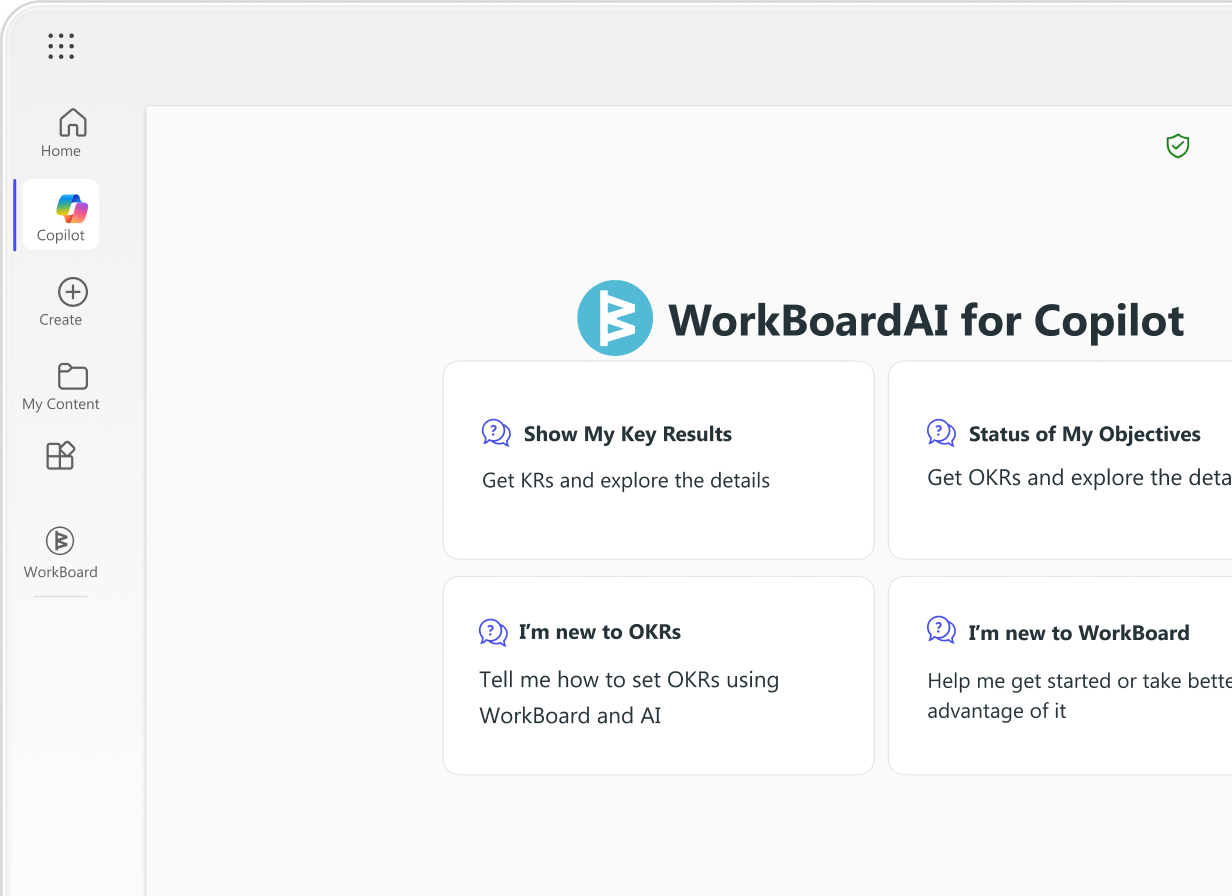
AI is changing customer experiences in banking, but its deeper impact is in how banks execute strategy. The real advantage comes when AI Agents remove the friction that slows alignment, clarity, and follow-through. Your AI Chief of Staff and Leadership Coach automate the work that drains leadership time — setting goals with better context, surfacing risks early, preparing weekly briefs, prompting updates, and coaching managers in the moment.
With consistent visibility and fewer surprises, teams stay focused on outcomes, not tasks and activity. Strategy becomes a continuous operating rhythm instead of a once-a-quarter lift. Financial companies that adopt AI for execution move faster, adjust sooner, and outperform the market (just like AssetMark, Capital One, Western Union, and more WorkBoard customers).
Learn more about WorkBoardAI.