Article Overview
Organizations thrive when they can shift focus quickly, incorporate new information, and realign execution fast. Yet while companies rely on change to grow, not all teams embrace it easily or at the same pace. This gap between the need for change and people’s willingness to adopt it is where leadership discipline, communication skill, and a strong operating rhythm matter most.
Effective change management provides the structure leaders need to reduce resistance, communicate intent clearly, and align people to a shared future state. A disciplined approach ensures teams move together, not in fragmented pockets, so the organization progresses at one pace toward one goal.
Below are essential components of change management to help you achieve organizational alignment, accountability, and clarity of outcomes.
Why change is essential
Innovation of all kinds is essential for organizations to grow and thrive; in fact, organizations that can more easily respond to new facts and conditions have a great advantage. In their book Super-Flexibility for Knowledge Enterprises, UC Berkeley’s Dr. Homa Bahrami and Carnegie Mellon’s Dr. Stuart Evans tell us that super flexible organizations are the most successful. These organizations have strong “circulatory systems” that foster idea flow, and they execute more dynamically. “Targeted experiments, openness to new data, fact-based assessment, and swift revisions" enable them to succeed while organizations that resist, ignore or are slower to respond to new ideas and conditions fail.
What Is change management?
Change management is a structured approach to helping individuals, teams, and entire organizations transition to a desired future state. The goal is to reduce uncertainty, strengthen engagement, and ensure that people move through the transition in a coordinated way that accelerates, rather than slows, execution.
Common scenarios include:
- Introducing new technology or tools
- Shifting strategy or priorities
- Redesigning processes
- Leadership transitions
- Cultural transformation
- Structural changes across teams
- Responding to crisis or market shifts
A strong change management discipline ensures these transitions are grounded in clear communication, consistent leadership behavior, and a systematic way of checking progress and adjusting plans.
The 5 R’s of change management
Here's a simple and practical framework for understanding the stages of organizational change:
1. Review
Assess the current state, identify the core problem, and clarify how the change aligns with strategic priorities.
2. Research
Gather the information you need to design the right plan for moving away from the status quo. This may include benchmarking, interviewing stakeholders, understanding customer or employee pain points, and evaluating systems or process gaps.
3. Remarket
Clarify the purpose of the change for employees and stakeholders. Communicate why it matters, how it ties to the strategy, and how it benefits different roles and functions. Communicating the why reduces resistance by showing people what’s in it for them.
4. Redesign
Adjust processes, roles, behaviors, or systems to support the intended future state. Redesigning thoughtfully creates the structures and workflows that allow the change to take hold and ensures teams have clarity on what success looks like.
5. Relaunch
Roll out the new processes or systems with clear goals, expected behaviors, and defined measures of success. Relaunching is not a single moment — it requires ongoing attention, transparent progress reviews, and reinforcement to maintain momentum at scale.
The 5 C’s of change management
The 5 C's is a framework that focuses on the human and cultural elements of effective change:
Communication
Clear, consistent communication accelerates adoption. Leaders should communicate purpose, expectations, progress, and changes in direction frequently through multiple channels. Repetition builds understanding and confidence.
Commitment
Visible leadership commitment is essential. Employees take their cues from what leaders do, not just what they say. Leaders must model the behaviors they expect from others and maintain accountability for the change over time.
Collaboration
Change succeeds when teams work cross-functionally. Collaboration reduces friction, surfaces interdependencies early, and ensures people understand how their work contributes to the larger outcome.
Compensation
Recognition reinforces the right behaviors. Celebrating early wins, progress, and adoption signals that the organization values the effort required to change. Recognition does not have to be monetary — frequency and authenticity matter more.
Culture
A culture that values transparency, accountability, and continuous improvement makes change sustainable. When people expect clarity, facts, and feedback in the normal rhythm of work, change becomes easier and far less disruptive.
4 steps to communicating your vision for change
People don’t embrace change at the same pace (and some never will). How you communicate new ideas plays a huge role in how well they're received and how quickly they're adopted. If you’re a change agent and innovator, it’s tempting to think that conveying your enthusiasm and excitement will accelerate others’ acceptance — turns out, that won’t work most of the time.
What’s compelling to innovators and change agents isn’t compelling to more pragmatic and conservative people; innovators are often in the small minority. Effectively communicating the need or reason to change is an important skill and a big factor in innovation velocity.
Understand why and when someone would change to better communicate why they should change.
To communicate with greater impact, focus on your audience as much as your idea. Tune in to where your audience is coming from before you try to persuade them where you want them to go — their starting point is as important as your destination.
Use these 5 questions to prepare and communicate your vision for change:
1. How does your audience react to change?
What excites change agents and visionaries rarely motivates conservatives and skeptics. Knowing what motivates your audience helps you make your message relevant to them.
Geoffrey Moore and Roger Everett brilliantly characterized the “adoption curve” to illustrate different responses to new ideas and the pace of their adoption. As an innovator, you are the exception rather than the norm. You generate ideas, see few risks and are excited by advancement. Pragmatics, on the other hand, are more analytical; they manage risk and are motivated by solving problems. Conservatives are more cautious, don’t like risks and are motivated by certainty. Skeptics reject or doubt most things, highlight risks and are difficult to motivate.
2. What’s their professional focus?
The concerns of senior executives and front-line practitioners are rarely the same, so map the scope and level of detail to your audience’s professional focus. Executives tend to watch metrics and focus on performance outcomes and results. Directors typically focus on process and are concerned with its reliability and predictability, while managers look at actions and focus on execution and priorities. Practitioners look at the details of their job and care about the steps and quality of the work. Talking to executives about detailed actions and sub-steps isn’t persuasive, and neither is talking to practitioners about metrics without the detail that applies to them.
3. Are they a captive audience?
If the audience reports to you, they’re watching what you do to decide how they feel about what you say. Make sure you’re modeling and demonstrating the behavior you’re asking for from them. Because they won’t all adopt at the same pace as you, persistence and consistency over time are required — an innovator mistake is to give up before slower adopters ever had time to change.
4. What’s in it for them?
Tune your message to people's personal motivators and professional perspectives to increase momentum and engagement. Create “what’s in it for you” slides or talking points designed for each audience so individuals can quickly understand why change is good for them — from their perspective of course. Sometimes four separate conversations with stakeholders can save four weeks of resistance from poorly-crafted general communications.
The companion infographic below and handy table here can help you frame your audience and talking points to your audience’s perspective:
.png)
How WorkBoardAI helps with change management
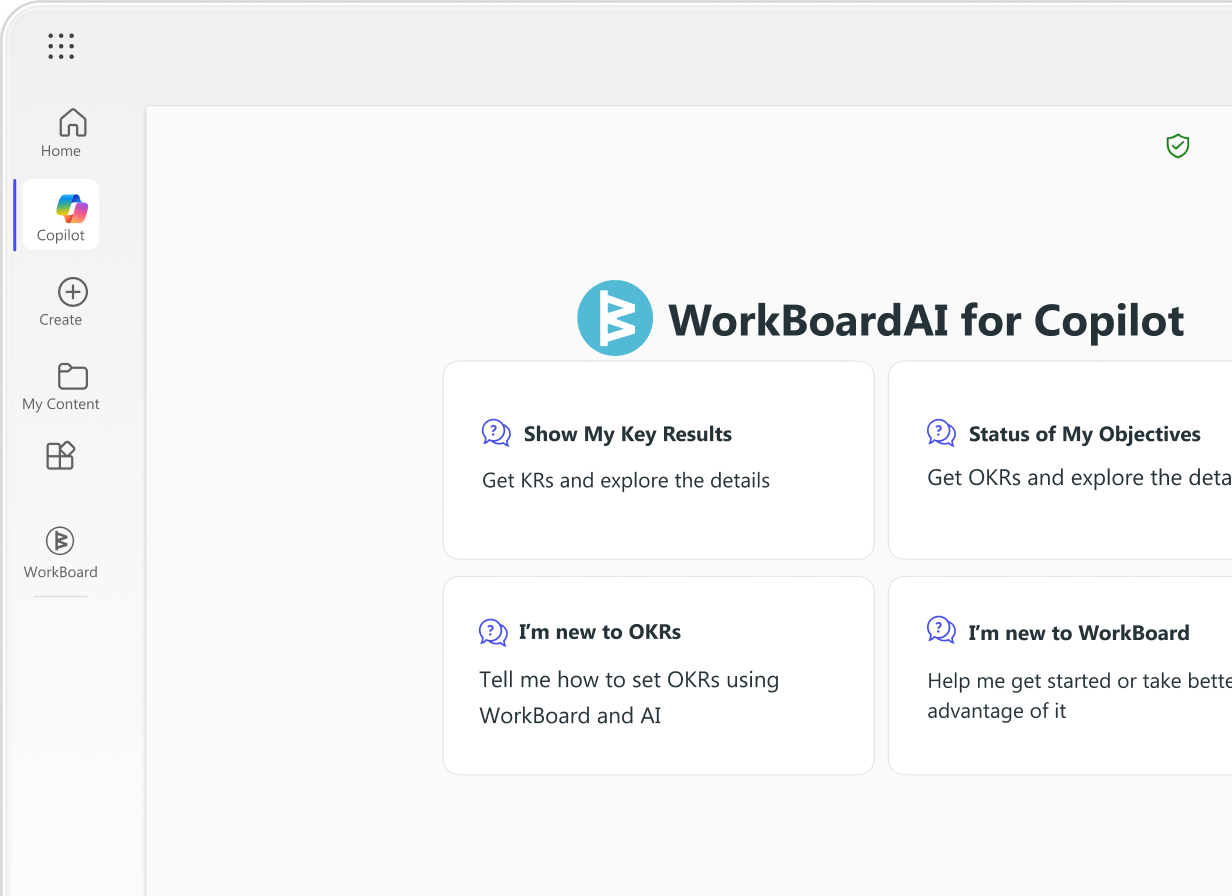
To illustrate how you can operationalize change, consider an organization facing execution gaps. Instead of guessing where friction sits, leaders use WorkBoardAI to gain clarity and align the organization.
1. Diagnose with clarity
Leaders use WorkBoardAI to identify where execution is slow, outcomes are off track, or work is disconnected. You can ask you WorkBoard AI agent to highlight patterns and risks with just a prompt. In seconds you get a scorecard and context to it explaining what's going on. As every great strategy execution partner, your AI agent will follow up with next steps.
2. Align on the right solution
Thanks to implementing clarity and transparency, teams reframe the change as a strategic improvement, not a disruption. WorkBoardAI helps clarify expected outcomes and cross-functional dependencies.
3. Structure the rollout
Using team and personal goals, tasks and projects, teams plan the change with clarity around who does what and by when.
4. Drive adoption in the flow of work
Leaders use AI agents to build and share interactive real-time business reviews and scorecards to reinforce accountability, recognize progress, and address resistance with data and empathy. Your AI Leadership Coach is your partner in leading with compassion, understanding and clarity.
5. Sustain progress
With OKRs refreshed quarterly and weekly AI progress summaries built into the operating rhythm, leaders gain always-on strategy execution visibility, teams maintain momentum and learn quickly from results.
Final words on change management
Change succeeds when intent is clear, communication is disciplined, and leaders reinforce expectations through consistent operating rhythms. WorkBoardAI helps leaders make the purpose of change explicit, align people to the outcomes that matter most, and maintain transparency as priorities shift. AI agents embedded in the system continuously track progress, surface resistance or drift, and highlight where reinforcement or course correction is needed.
By pairing an outcome mindset with AI agents that keep execution visible week to week, organizations reduce uncertainty and accelerate adoption. Leaders gain early signal instead of late surprises, teams understand how their work connects to the change, and operating rhythms become mechanisms for learning and adjustment. The result is faster change, stronger accountability, and greater confidence that the organization is moving in the right direction.
Learn more about WorkBoardAI.