Article Overview
Organizations often underestimate the complexity of executing their strategy. Defining the strategy is only the first step. The real work begins when leaders translate intention into measurable outcomes, ensure teams understand their contribution, and maintain a consistent rhythm to evaluate progress and adjust course.
Strategy execution is not a linear exercise or an annual event. It is a continuous cycle of planning, aligning, executing, and adapting as conditions evolve. Effective execution requires clarity of direction, disciplined alignment across teams, and a transparent operating model that turns strategy into weekly and quarterly action.
The following sections outline a modern perspective on strategy execution, why it remains difficult for many organizations, and how a systematic approach helps leaders close the gap between strategic ambition and execution reality.
What is strategy execution?
Strategy execution is the process of aligning the organization’s strategic focus with decisions, priorities, and daily work. It ensures that teams understand the outcomes the company is driving toward and how their efforts contribute. Strong execution also creates the conditions for faster decision-making, better resource allocation, and greater agility.
When organizations execute well, they benefit from:
- Clear direction: People understand what matters most and why.
- Improved decision-making: Leaders make better choices with real-time insights.
- Enhanced performance: Teams focus on outcomes, not activity.
- Higher engagement: Employees see how their work connects to strategy.
- Long-term resilience: Strategic focus remains strong even as conditions change.
Execution is where strategy becomes meaningful and impactful.
Why strategy execution is difficult?
Many organizations struggle to execute effectively because the path from strategy to action is not inherently intuitive or simple. Common challenges include:
1. Bridging planning and execution
Leaders often define strong strategies but struggle to translate them into clear, measurable, time-bound outcomes. Without a structured process, teams lack clarity on what to prioritize.
2. Complex organizational structures
As organizations grow, communication channels multiply. Alignment across geographies, functions, and operational layers becomes harder without shared context and shared facts.
3. Sustaining alignment and momentum
Competing priorities, shifting demands, and unclear expectations can slow execution, dilute focus, and cause teams to drift from strategic intent.
4. Cross-functional collaboration
Vertical alignment is common but cross-functional alignment is rare. Strategic outcomes typically depend on multiple teams working together, not independently.
5. Measuring progress with accuracy
Without reliable data and consistent measures, performance reviews become subjective, late, or disconnected from strategic outcomes.
6. Shallow alignment
Many teams continue tracking activities and outputs while executive teams evaluate progress through outcomes and results. Without a shared definition of success, teams make reasonable but often disconnected assumptions about where to invest time.
“We were aligned on the strategy on the page, but we weren’t aligned on the execution. You have to focus on making 1% progress everyday. But if you don’t align, you all end up moving 1% everyday in random directions.” — Gee Rittenhouse, Chief Executive Officer, Skyhigh Security
7. Limited visibility on progress
Teams work hard, yet leaders struggle to see where commitments are on track or slipping. This disconnect dilutes accountability and turns reviews into reporting exercises rather than decision-making forums.
“Our Monthly Operating Committee was a four-hour stoplight status conversation. We lacked accountability and a common definition of success. The cost of this meeting was $50,000 every month. So we asked, are we getting $50k worth of value out of this? Absolutely not.” — Ryan Padilla, Head of Strategy Operations, GHX
8. Lack of clear focus
When people are unsure what truly matters, they hedge by attempting to do everything. Priorities multiply, decisions escalate upward, and teams stay busy without creating meaningful impact.
“It's not about these activities and those initiatives and how many projects you have simultaneously. But can you ruthlessly prioritize to the point of impact and do those things that are most impactful rather than just keeping you busy.” — Cindy Hoots, CIDO, AstraZeneca
Organizations that succeed in strategy execution build a systematic, transparent process that reduces ambiguity and reinforces focus year-round.
A clear framework for strategy execution
While strategy execution varies across organizations, effective execution typically includes these continuous phases:
1. Plan
Define long-term strategy and articulate the outcomes that reflect strategic success.
2. Align and activate
Translate strategy into annual and quarterly results, clarify interdependencies, and coordinate teams around shared priorities.
3. Execute
Ensure decisions, actions, and communication reinforce alignment and accelerate progress.
4. Assess and adapt
Use real-time insights to refine direction, adjust priorities, and improve both strategy and execution.
Organizations that operationalize this cycle build strategic agility and strengthen performance.
A systematic way to get strategy execution right
Strategy execution is driven by an organization's operating cadence of rituals and actions that focus attention on the organization’s intention — its strategy. These rituals define the frequency of iteration, measurement and assessment of the strategy and execution progress.
For successful strategy execution, you will need:
1. The strategy you want to achieve
With WorkBoard, business leaders can define their multi-year strategy and easily communicate it across the organization:
- Align on pillars and outcomes
- Measure results and risks
- Define investments
- Align related strategies, mission and vision
- Strategy on a page
- Publish and disseminate
2. Aspects of strategy to achieve this year
WorkBoard's Objectives & Key Results (OKR) capabilities make it easy for teams to align on how they want to progress the long-term strategy this quarter and this year:
- Align objectives and key results
- Set target outcomes and results
- Update progress on results
- Source actuals from systems and people
- Plan vs actual visibility
- Risk and velocity alerts
3. Accountability for outcomes and actions
With WorkBoard's Scorecards and Ops Reviews, leaders can measure and communicate real-time OKR progress and flag risks, all without copying and pasting data.
- Scorecards of planned vs actual key results
- Leading and lagging measures
- Biz and ops reviews with status of strategy, objectives and results, and workstreams
- Organize by meeting/audience
- Single source of truth on plans and actuals
4. Actions needed to achieve to execute well
Workstreams and Action Items help organize the execution of strategic initiatives in support of this quarter's OKRs:
- Identify and organize work to be done
- Assign actions and owners
- Track status of each action
- Manage status and health of workstreams
- Sprint, board, list and persona views of work
Let us show you how WorkBoard can help you with setting strategy and improving your operating rhythm.
Connecting framework to system
WorkBoard’s systematic approach provides the operational structure needed to turn strategic intent into measurable business outcomes. When paired with a broader understanding of the strategy execution cycle (Plan → Align → Execute → Assess), organizations can:
- ensure strategic intent is clear across all levels
- align teams around annual and quarterly results
- maintain visibility into progress and risk
- create accountability without added overhead
- translate strategy into coordinated action
- continuously adjust direction based on real-time insight
This combination of conceptual clarity and operational rigor is what enables strategy to be executed consistently and at scale.
.png)
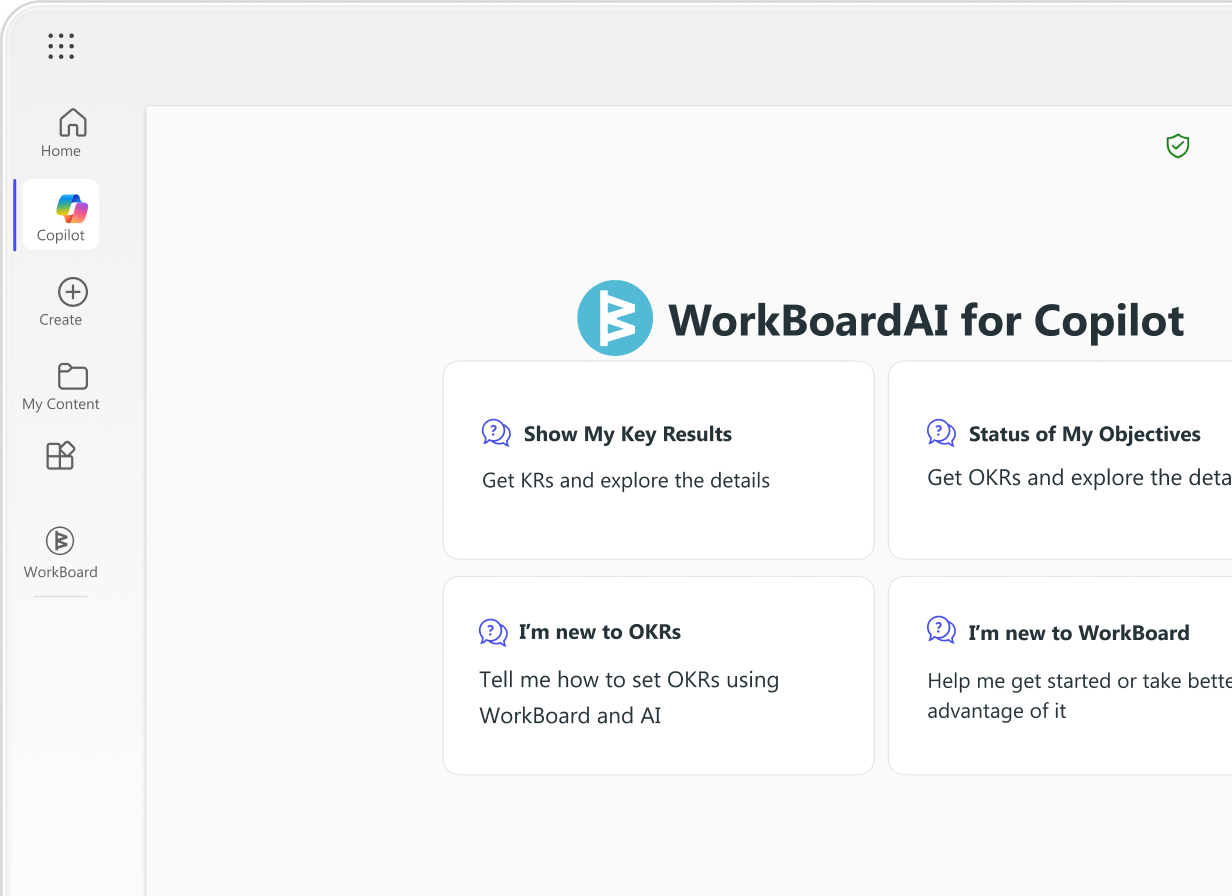
How WorkBoardAI strengthens strategy execution
The growing pace of change increases the need for real-time insight, early risk detection, and faster decision cycles. WorkBoardAI enhances execution discipline by embedding intelligence directly into the operating rhythm:
- AI Agents and AI Briefs summarize goal progress, strategic risks and team/individual performance for always-on execution
- Goal heatmaps, scorecards and executive dashboards surface real-time data without manual effort
- The AI Leadership Coach reinforces accountability and help leaders prepare for priority conversations
- Early signals help teams anticipate issues rather than react to them
Leaders gain the clarity and context needed to make informed decisions. Teams stay aligned because goals, insights, and facts are always present in the flow of work.
Strategy execution improves when clarity improves and WorkBoardAI ensures that clarity is available continuously.
Want to see how WorkBoardAI improves strategy execution? Book a demo.