Article Overview
Need OKR examples? You landed on the right spot! Quarterly OKRs help organizations create clarity, drive alignment, and focus people on the outcomes that matter most. The examples below illustrate how functions can set meaningful objectives that reinforce strategic priorities.
This guide includes a comprehensive list OKRs by function and team. But before we dive into the examples, let's start with the basics.
What Are OKRs
OKRs connect your strategic ambitions to the work teams do every week. They pair a clear objective with a small set of measurable key results so everyone understands what matters and how progress is defined.
Objectives describe what you intend to achieve.
Key results measure progress toward that intention with precision.
Effective OKRs are:
- Significant and worth the organization’s time
- Concrete and tied to real outcomes
- Easy for people to understand and act on
- Measured in a way that leaves no debate about progress
OKRs create the shared language that helps teams see how their work drives the company strategy. They increase transparency, reduce friction, and enable cross-functional alignment so the whole organization can move with clarity, confidence, and speed.
With this in mind, let's dive into the OKR examples by function and team.
Company-Level OKR examples
Objective 1
Improve our financial position to support long term growth
Key result 1: Increase cash collections to 1.2 million
Key result 2: Hold operating expenses below 1.1 million
Key result 3: Maintain quarterly growth at 40 percent
Objective 2
Delight our customers
Key result 1: Achieve an NPS above 24
Key result 2: Increase net revenue retention above 100 percent
Key result 3: Sustain high engagement with more than 80 percent weekly active users
Executive Leadership Team OKR examples
Objective 1
Optimize our unit economics that maximize our ability to grow
Key result 1: Grow net new Monthly Recurring Revenue (MRR) from 211.6M to 435.1M
Key result 2: Accelerate Customer Acquisition Cost (CAC) payback period for new deals from 10 months to under 8 months
Key result 3: Sharpen Lifetime Value (LTV) to Customer Acquisition Cost (CAC) from 3.1 to 3.6
Key result 4: Increase cash flow by improving gross margins from 74 percent to 79 percent
Key result 5: Achieve quarter over quarter Earnings Per Share (EPS) of 1.38 from 1.09
Objective 2
Prosperous company outlook fueled by customers for a lifetime
Key result 1: Challenge ourselves to minimize customer churn rate at 2 percent or lower
Key result 2: Responsible C-Suite members meet all renewing customers above 50M to ensure they continue to value our products and services
Key result 3: Expand average user account activations across all accounts from 74 to 82
Key result 4: Expand Gross Revenue Retention (GRR) from 98 percent to 113 percent
Objective 3
Our culture allows our people to achieve their fullest potential
Key result 1: Achieve more than 65 percent Employee Resource Group participation
Key result 2: Targeted underrepresented groups comprise 35 percent of internal promotions at Director level and above
Key result 3: More than 90 percent of our people report understanding how their work aligns to our strategic priorities
Key result 4: At least 50 percent of all candidates interviewed come from targeted underrepresented groups
Objective 4
Our team members thrive on diversity in the face of adversity or prosperity
Key result 1: All people managers conduct 1:1s at least twice per month
Key result 2: 100 percent completion of personal growth and development plan conversations with at least one further action identified
Key result 3: 60 percent of people managers complete all segments of Managing in Challenging Times
Key result 4: Strengthen inclusive culture with all employees reading and accepting the anti-discrimination policy and pledge
Key result 5: At least 45 percent of new hires come from targeted underrepresented groups
Objective 5
Unified value across the customer journey from marketing, sales, product, onboarding and instrumentation
Key result 1: Position a unified value proposition across the entire customer journey
Key result 2: High value strategic use cases embedded in all six functions
Key result 3: Ten Tier 1 customers actively using KT22 insights
Key result 4: Twenty five customers use and integrate our product into their primary management metrics
Key result 5: Publish five Tier 1 customer testimonials
Key result 6: Recruit five new customer champions
OKR Program Team OKR examples
Objective 1
Give time back to our employees via platform performance and data insights
Key result 1: OKRs viewable in less than one second
Key result 2: More than 50 percent of key results updated automatically through integrations
Key result 3: Reduce business review preparation from 12 hours to 1 hour
Key result 4: Build cross-functional alignment with all OKRs aligned in the platform
Objective 2
Advance the achievement of our strategic priorities by leveraging our OKR data
Key result 1: Review result patterns for every team before workshops
Key result 2: Identify and share three best practices that drive at least 10 percent higher results
Key result 3: Improve quarter over quarter results by at least 15 percent on average
Key result 4: OKR coach community audits all team key results for data integrity
Objective 3
Challenge teams to embrace best possible outcomes with clarity and transparency
Key result 1: 100 percent of targeted teams have value driven outcomes with defined metrics
Key result 2: More than 90 percent of individuals understand our strategic priorities
Key result 3: Create 45 dynamic teams with defined OKRs
Key result 4: At least 50 percent of executive business reviews created and presented in the platform
Key result 5: At least 65 percent of teams mid-quarter at amber status on the heat map
Key result 6: 75 percent or more of key results updated on their measurement cadence
Objective 4
Teams are embracing OKRs to drive outcomes that matter
Key result 1: All targeted teams publish OKRs with at least one update per key result in month one
Key result 2: Results Management Office codifies three best practices and shares them broadly
Key result 3: 75 percent of targeted team OKRs aligned in the platform
Key result 4: 65 percent of teams run business reviews in the platform
Key result 5: Quarterly town halls recognize OKR successes and learnings
Biz Dev Teams OKR Examples
Objective 1
Acquisition team amplifies the successes of our acquired companies
Key result 1: Publish monthly employee newsletter on strategic intent
Key result 2: Prevent any regrettable people losses
Key result 3: More than 90 percent of employees understand the strategy
Key result 4: Maintain deal cycle time at or below 97 days
Key result 5: Match acquired talent with a buddy
Objective 2
Realize the business value of our recent Formix acquisition
Key result 1: Host monthly lunch and learns with at least 45 percent attendance
Key result 2: Incorporate at least three acquired features into the roadmap
Key result 3: Enable 85 percent of sellers on the value proposition
Key result 4: Win eleven new logos above 24M in the energy sector
Objective 3
Be the strategic growth advisor for the business
Key result 1: Achieve minimum rating of eight out of ten on market and portfolio analyses
Key result 2: Analyze ten technology companies and recommend paths to close seven growth gaps
Key result 3: Three of five recommendations from the growth vision deck adopted
Key result 4: Secure buy in for exploratory diligence on two key technology gaps
Key result 5: Identify twenty early stage companies with synergy potential
Objective 4
Prevail as the partner, investor or acquirer of choice
Key result 1: Facilitate introductions for forty five innovator companies and capture two benefits for each
Key result 2: Conduct baseline reputation survey with one thousand technology companies
Key result 3: C-Suite meets with at least three companies on the Top 100 list
Key result 4: Develop an executive talk track supported by at least five value tactics
Objective 5
Build stronger alliances and trust within the business
Key result 1: All team members complete a two week rotation with business counterparts
Key result 2: Participate in every BU strategy planning process
Key result 3: Hold bi-weekly huddles with EVP Product in automotive and energy
Development Teams OKR examples
Objective 1
Scalable and high quality solutions fuel our growth
Key result 1: Average server response time under 500 milliseconds
Key result 2: Reduce P0 and P1 bugs to four or fewer per month
Key result 3: Maintain platform uptime above 99.99 percent
Key result 4: Automate regression testing for all production code
Key result 5: Achieve bug turnaround time under 48 hours in JIRA
Objective 2
Tap into the power of analytics to create a differentiated product
Key result 1: Stand up six data science prototypes
Key result 2: Identify two machine learning opportunities for regression testing
Key result 3: Increase analytics skills with more than 50 percent of the team completing advanced training
Key result 4: Run three data experiments and incorporate learnings
Objective 3
Leverage our learnings to increase quality with every product delivery
Key result 1: Conduct retros with all learnings documented
Key result 2: Reduce customer reported P0 and P1 bugs to two or fewer per month
Key result 3: Limit repeat production bugs to one or fewer
Key result 4: Achieve 95 percent test coverage for all production code
Key result 5: Explore three automations that reduce future spend and increase quality
Objective 4
As code experts we celebrate our successes and learnings every day
Key result 1: Hold weekly celebrations for feature launches
Key result 2: All team members have development plans reviewed twice yearly
Key result 3: Hire two software architects to close skills gaps
Key result 4: Improve team spirit with three events and 65 percent average participation
Key result 5: Host two tech events where each attendee reports at least two new learnings
Customer Experience Teams OKR examples
Objective 1
Excite and expand our customer base
Key result 1: Incorporate four customer learnings that improve retention
Key result 2: Retire 39M upgrade quota
Key result 3: Host two lunch and learns with the developer community
Key result 4: Achieve 84M in monthly revenue retention
Objective 2
RevOps data and insights drive our most important decisions
Key result 1: Centralize all RevOps requests in Zendesk
Key result 2: Define and publish RevOps SLAs
Key result 3: Baseline tools usage metrics for expansion opportunities
Key result 4: Provide real time RevOps workstream intake visible to the company
Objective 3
Provide exceptional customer experience that extends customer lifetime
Key result 1: Ensure 100 percent of new accounts use high value features twice per week
Key result 2: At least 50 percent of customers use differentiated features
Key result 3: Improve retention accuracy within 2 percent of the 103 percent target
Key result 4: Reduce average call waiting time from 180 seconds to less than 60
Key result 5: Implement three of five customer tracking enhancements
Objective 4
Customer Experience team exceeds expectations
Key result 1: All new hires achieve the combined retention target of 112M
Key result 2: Five new CSMs onboard their first account
Key result 3: Reduce P1 ticket response times by 50 percent
Key result 4: Hold three knowledge seminars with two learnings per attendee
Marketing Teams OKR examples
Objective 1
Enable the sales team to open, win and close more deals
Key result 1: Deliver 128M in enterprise pipeline value
Key result 2: Develop pipeline of ten new logos worth at least 14M annually
Key result 3: Generate 3,000 qualified inbound leads above 100K
Key result 4: Achieve 12 percent conversion on online product demos
Objective 2
Empower Sales with imaginative and engaging assets
Key result 1: Publish six case studies
Key result 2: Create persona based messaging and solution packages
Key result 3: Revamp collateral for each of the six sales cycle stages
Key result 4: Increase collateral usage by 20 percent
Key result 5: Hold three sales enablement sessions with two learnings per attendee
Objective 3
Our content establishes us as thought leaders
Key result 1: Publish five blog posts that generate at least 125 demo requests
Key result 2: Increase blog subscribers by ten percent
Key result 3: Increase website traffic by fifteen percent
Key result 4: Hold three thought leadership events resulting in 700 new subscribers
Objective 4
We are a passionate learning team that drives our market opportunity
Key result 1: Every team member chooses a development skill and completes training
Key result 2: At least two team members present at an industry conference
Key result 3: Establish a mechanism to share best practices
Sales Teams OKR examples
Objective 1
Diversify achievement of sales targets with mixed products and services
Key result 1: Capture 176M in North America bookings for Stratus
Key result 2: Capture 127M in EMEA bookings for Stratus
Key result 3: Build 22M pipeline for Wombat stage 2 or later
Key result 4: Secure 20 Wombat pilots in early adopter accounts
Key result 5: Ensure every representative closes at least 21.1M with no more than 45 percent from a single product line
Objective 2
Our data driven approach optimizes our sales engine
Key result 1: Complete SFDC cutover
Key result 2: Ensure all validated opportunities are in SFDC
Key result 3: Increase pipeline coverage from 3x to 4x
Key result 4: Increase average deal size from 2.1M to 9.7M
Key result 5: Confirm all MQLs within 7 days
Objective 3
Slay the competition in the marketplace
Key result 1: Systematize demo rotation, skip logic and activity goals
Key result 2: Increase win rate for F500 and G200 companies from 55 percent to 65 percent
Key result 3: Grow MRR from 237M to 311M
Key result 4: Win thirty new logos above 15M
Objective 4
We are intentional about improving our win rate
Key result 1: Ensure 20 percent of demos reach the C-Suite
Key result 2: Maintain 95 percent pricing compliance
Key result 3: All team members complete negotiation skills training
Key result 4: Provide two hours of 1:1 enablement coaching per month
IT Teams OKR examples
Objective 1
Invest in tools and systems that empower our people
Key result 1: Reduce monthly close from 7 days to 3
Key result 2: Shorten procurement time from 30 days to 7
Key result 3: Deliver full wifi coverage with 99.999 percent uptime
Key result 4: All employees complete help desk training with an average rating of 8 out of 10
Objective 2
Streamline operations by shifting our infrastructure to the cloud
Key result 1: Decommission five data centers
Key result 2: Migrate twelve apps to SaaS
Key result 3: Reduce data migration time from 14 days to 3
Key result 4: Reduce storage and infrastructure costs by 74M
Objective 3
Learning is our passion and priority
Key result 1: Hold monthly lunch and learns with 35 percent average attendance
Key result 2: Create time for weekly passion projects
Key result 3: Everyone identifies and learns one new technology
Key result 4: IT leadership sponsors two experimental projects and shares results
Objective 4
Be the system architects of our future
Key result 1: Deploy three blockchain use cases in non-production
Key result 2: Incorporate four chatbot use cases into production
Key result 3: Increase team members who can code from 35 percent to 55 percent
Key result 4: Ensure 100 percent of system investment decisions follow data driven evaluation
DE&I initiatives OKR example
Objective:
Strengthen belonging and equitable opportunities across the organization
Key result 1: Launch two inclusive leadership workshops with 95% attendance
Key result 2: Increase diverse candidate interview slates to 70% across roles
Key result 3: Boost participation in employee resource groups by 40%
Design teams OKR example
Objective:
Enhance the onboarding experience to increase user activation
Key result 1: Reduce onboarding flow friction points from 6 to 2
Key result 2: Improve activation rate from 42% to 60%
Key result 3: Increase completion of first key action within 24 hours from 30% to 55%
Finance teams OKR example
Objective
Increase financial predictability and operational efficiency
Key result 1: Improve forecast accuracy from ±12% variance to ±5%
Key result 2: Reduce monthly close time from 10 days to 6 days
Key result 3: Increase on-time vendor payments from 85% to 98%
HR teams OKR example
Objective
Strengthen employee engagement and manager effectiveness
Key result 1: Raise manager effectiveness score from 3.6 to 4.3
Key result 2: Achieve 95% completion of quarterly pulse surveys
Key result 3: Deliver five manager-led development sessions with full team attendance
Operations teams OKR example
Objective
Increase operational clarity and efficiency across teams
Key result 1: Standardize agendas and decision logs for 90% of recurring meetings
Key result 2: Reduce meeting hours per person per week by 20%
Key result 3: Publish department-wide meeting norms and adopt them across eight teams
Product teams OKR example
Objective
Improve delivery predictability and customer impact
Key result 1: Increase roadmap delivery predictability from 68% to 90%
Key result 2: Reduce severity-1 defects from 12 per quarter to 4
Key result 3: Cut cycle time from concept to release from 14 weeks to 8 weeks
Why OKRs with WorkBoardAI?
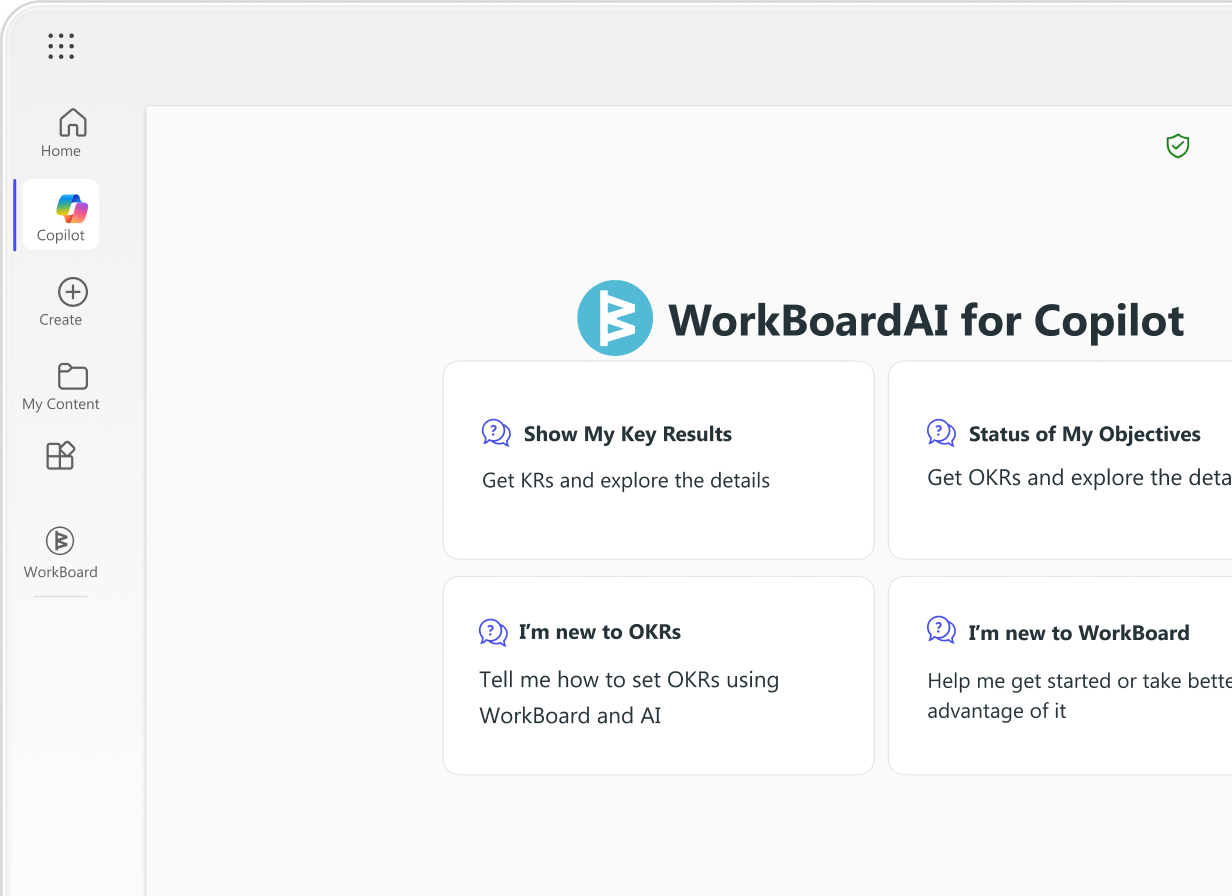
WorkBoardAI helps teams build stronger OKRs by embedding AI agents directly into the strategy execution system. These agents understand your organization’s structure, strategy, and historical execution patterns, and work continuously to improve how outcomes are defined, aligned, and achieved. Instead of starting from a blank page each quarter, teams get informed guidance grounded in how the business actually runs.
“The AI co-author tool is amazing… it gives you suggestions on what an effective OKR looks like — meaningful, measurable, outcome oriented.” — Esi-Minta Jacobs, AssetMark
AI agents in WorkBoardAI support leaders and teams by:
- Recommending objectives and KPIs based on current company strategy
- Suggesting measurable key results that reflect leadership intent and ambition
- Identifying where alignment exists and where it is weak or missing across teams
- Drafting OKRs that are outcome-oriented, clear, and actionable
- Scoring OKRs for clarity, focus, and measurability to raise quality before execution begins
Because AI agents reduce the administrative lift and reinforce alignment from the start, teams move faster with less friction. Weekly insights and automated scorecards help leaders stay focused on what matters most, surface risk early, and keep the strategic through line visible at every level of the organization.
Hear how Western Union uses WorkBoardAI to improve OKR creation and management:
Want to learn more about WorkBoardAI? Book a demo