Article Overview
WorkBoard CEO and Co-founder, Deidre Paknad, joined Daniel Eisenberg, an Executive Editor at McKinsey & Co., for a recent conversation that explored the genesis of WorkBoard, the imperative for digital inclusivity, and what enterprises of all sizes can learn from the constraint mindset of startups.
Your strategy is how you will realize your vision in the coming years and where you will allocate resource and focus attention to do so. A robust strategy provides radical clarity on what you won’t do so you can concentrate energy where you can win.
Strategy development is messy work. A strategy is a set of choices, and the hard part is often identifying valid alternatives for sustainable value. Culture norms, attachment to the current choice, and inertia can hinder teams’ ability to consider potential paths to their vision.
Good strategy is a robust hypothesis for how you will achieve your vision.

The company’s overall strategy drives the strategies for business units, product families, go to market, technology, customer experience and more. Each of these aspects of the business warrants long-range thinking, and each must align its long-range outcomes to company outcomes.
Developing strategy is both art and science
Research and data are important, but lived experience and judgment are equally important. Developing the strategy is simple but not easy because it involves making bets on the future and choices for where you will focus effort.
Good strategy is a robust hypothesis for how you will achieve your vision.
A good strategy provides radical clarity on what you won’t do so you can be most successful. To develop your explicit strategy, allow time for the team to identify, weigh, consider and compare paths and options.
- Given competitive pressure points, what is the best way to win?
- Given market opportunities and risks, what is the ideal situation in the future?
- Given enterprise strategy, what must be elevated to achieve it?
- Given alternatives for resources, what’s the smartest choice?
Aligning on the strategy is a pre-requisite to executing on it, and a common syntax for strategy makes alignment possible. If your organization has 6 or 7 different frameworks for strategy, it actually has none. No one knows how to reconcile them or which one trumps the others at decision time.
A strategy has several canonical elements:
- Horizon: The time period for achievement and for which you’re defining future outcomes.
- Narrative: Your beliefs, related trends, and the drivers that inform your strategy.
- Pillars: The 3-4 primary levers you will pull or routes you will take to win.
- Business Outcomes: Measurable business impacts you expect at the end of the horizon for each pillar
- Assumptions & Risks: Assertions about the state of your world that must be true for the strategy to be realized and negative potential that would block achievement
- Investment Plan: The resources and efforts it will take to realize the strategy
Each element is important to the definition, utility, and achievement of the strategy over time. By using a common structure for strategy across the organization, you can demystify what strategy really is as well as fortify strategy creation and coherence.
Your strategy doesn’t live in isolation. It may line up to a company strategy or business unit strategy, or it may require other teams to create those strategies in unison with yours.
Because strategy attempts to define a future state, it must be both codified and re-evaluated on a frequent basis as markets and facts evolve. That’s where OKRs come in.
Strategy drives OKRs, but OKRs aren’t strategy
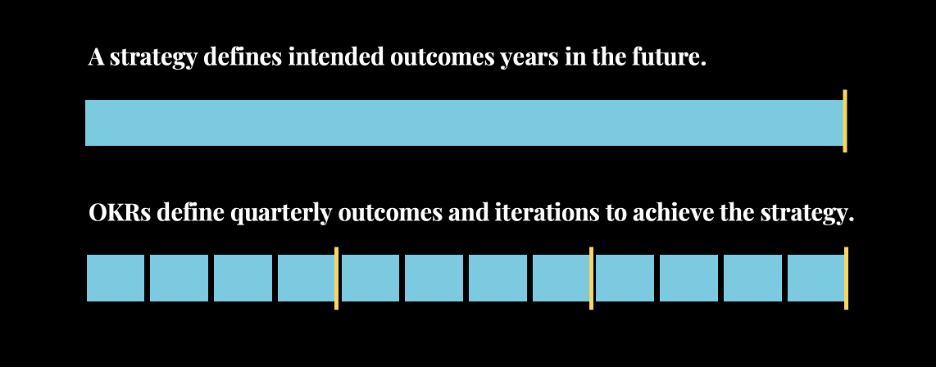
OKRs activate the strategy and define which parts of it we will execute in each quarter. They are a mechanism for aligning time and effort to the strategy right now. One of the pitfalls in simply stating the 5-year strategy is no one knows where to put their efforts in the next 90 days — OKRs drive clarity and alignment on what is first and most important in the near term to achieve your strategy in the long term.
Because OKRs focus on aligning outcomes, they help you avoid one of the largest strategy execution gaps: No one knows the outcomes needed and the output never adds up to strategic outcomes. The yellow side of the table below shows a typical strategy-activity path where tasks gets done but product and distribution don't improve. OKRs help teams think through the outcomes that drive strategy, as you see in the blue side of the table.
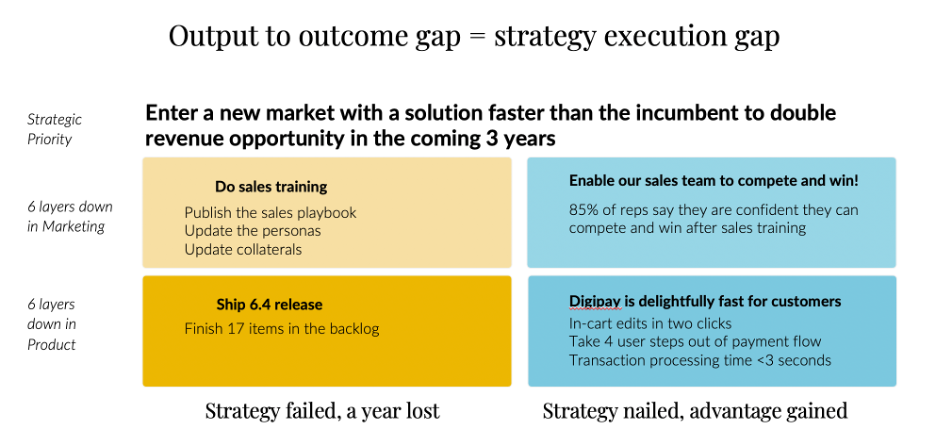
OKRs help us iterate forward with speed and agility toward our strategy as the world changes. They put the strategy into motion now and help you test assumptions. Strategy is a future destination; OKRs are the GPS that help you get to your destination.
Map your OKRs to the strategy, and — where appropriate — your key results to a given outcome. As you reset OKRs for a quarter, bring your strategy into the conversation: Did the key results prove or disprove your assumptions? What new risks arose? Are the results adding up to the long range outcomes as expected?
Strategy execution is purposeful achievement
When the long-range strategy drives current quarter objectives and results, and those OKRs in turn drive actions, organizations achieve their strategies. As simple as it sounds, most companies don't achieve their strategy because they don't intentionally drive the clear link between these elements — they leave it to chance.
More often than not, the strategy is not well understood below the senior leader level and has no impact on the week-to-week actions of the broader organization — this is a recipe for failure. (What did your last employee survey say about how well the strategy is understood?)
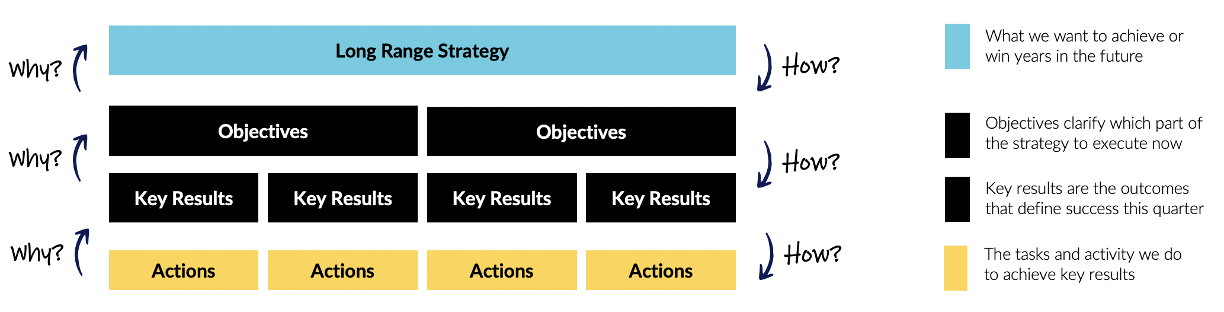
Strategy execution comes from a set of operating behaviors, rituals and actions that focus attention on the organization’s intention — its strategy. These collectively are the organization’s operating rhythm, and their purpose is to ensure its execution of the strategy.
Aligning on the strategy is a pre-requisite to executing on it.
A slow, sloppy operating rhythm will result in slow, sloppy strategy execution. If the strategy isn’t threaded through your OKRs, MBRs and weekly meetings, then you’re using a great deal of resources and wasting a great deal of time without executing on your strategy.

As we stand on the cusp of recession, no organization has time or resources to waste and most have important transformations and opportunities to execute on. OKRs in a Modern Operating Rhythm should be every organization's new year’s resolution.
Extending Strategy into a Modern Operating Model
While strategy is the hypothesis for how you will win, the operating model is the system that helps you deliver on that hypothesis every day. In a fast-changing world, organizations need an operating model that strengthens alignment, accelerates decision-making, and adapts quickly to new conditions.
A modern operating model has five core components. Together, they form an ongoing discipline for how strategy is executed at scale.
1. Define the destination
Your mission, values, vision, and strategy work together to provide a clear north star. When teams understand where the organization is headed and why, they make better decisions about what matters and what does not. Misalignment at this level leads to conflicting priorities, slower execution, and erosion of trust.
2. Change the business
Strategic objectives and OKRs quantify the future state and make it actionable. They translate the strategy into outcomes the organization can align and work toward. Clear objectives sharpen prioritization, reduce wasted effort, and help teams see how their work contributes to long-term goals.
3. Run the business
Running the business requires observability. KPIs provide quantitative signals about performance and health, while OKRs reveal progress toward outcomes. Together, they create visibility into where results are strong, where risks are emerging, and where decisions need to be made. External signals such as market shifts and customer needs inform necessary adjustments.
4. Do the work
Daily work should align with the strategy and OKRs. The ideal execution environment has:
- Engaged teams
- Clear ownership
- Transparency across functions
- Data-informed decision-making
- A bias toward outcomes
- Continuous learning and improvement
This environment enables speed, accountability, and higher-quality execution.
5. Assess and adapt
As conditions change, organizations must assess what they are learning and adjust the strategy and OKRs accordingly. Reviewing results, identifying risks, and refining plans help maintain momentum and relevance. Adaptability becomes a competitive advantage.
Bringing It All Together
When your strategy defines the future, your OKRs activate the right near-term outcomes, and your operating model provides the structure and rhythm for execution, your organization moves with clarity and speed. Strategy becomes more than a document. It becomes a living system that guides decisions and actions across the business.
A modern operating model reinforces the strategy by keeping the entire organization aligned, informed, and focused. It enables teams to execute with greater discipline and empowers leaders with the insight needed to steer through change.
How WorkBoardAI helps you build operating rhythm that works
WorkBoardAI makes the operating rhythm far easier to run and dramatically more effective. AI Agents assemble scorecards, spotlight risks, summarize OKR progress, and surface trends instantly — giving leaders the facts they need without the manual effort that slows most organizations down. The same intelligence strengthens business reviews, weekly meetings, and quarterly recalibration by putting outcome progress, dependencies, and velocity front and center, so teams stay aligned on what matters most.
At the team level, WorkBoard’s AI Leadership Coach elevates 1on1s and daily management by providing insights on progress, workload, roadblocks, and follow-through so managers walk in prepared to coach, calibrate, and help people succeed. Across scorecards, OKRs, 1on1s, and operating cadences, AI ensures every conversation starts with clarity and ends with action. The result is an operating model that adapts quickly, executes with discipline, and accelerates company progress week over week.
Let us show you how WorkBoard can help you with setting strategy and improving your operating rhythm — or drop me a note and I'm happy to share!