Article Overview
Nobody talks about OKRs in revenue organizations.
There’s a ton of conversation on their importance in product and engineering teams. All valid. But the revenue org is often left out.
For a long time, people kept OKRs separate from KPIs. The thinking was: don’t let OKRs just become revenue metrics. Don’t tie them to comp plans. Keep them aspirational. But in 2025, that separation adds confusion. OKRs and operating metrics should be visible together and serve different purposes. They need to work together.
Why OKRs in the revenue org are important?
That starts with bringing both into a shared view. In most revenue orgs, KPIs are scattered. Salesforce, spreadsheets, LinkedIn, website. To drive focus, show what is changing in the same place people manage their OKRs. Then the value comes from how OKRs are used. In a revenue org, they can do two things really well:
1. Drive change
If CAC is getting worse or conversion rates are sliding, sales OKRs give you a way to fix the root cause. The sales team could commit to faster lead follow-up this quarter. Example: “Reduce average lead response time from 12 hours to under 6.” That behavior is measurable, time-bound, and directly tied to improving stage 0 to 1 conversion.
You should see the impact on the KPI in the next period. It’s about identifying the problem, using the OKR to drive behavior change, holding teams accountable, and seeing progress.
2. Align teams around the funnel
Say you are launching a new product. Marketing drives awareness, sales starts conversations, customer success ensures adoption, and product tracks usage. Each owns part of the funnel. OKRs help show the full system and where it breaks down. If awareness is not converting, it is not just a marketing problem. It is a shared opportunity to improve. For example:
- Marketing: Reach 1,000 qualified contacts
- Sales: Run 500 discovery conversations
- Customer success: Enable 100 customers
- Product: Weekly usage across those 100 accounts
This creates the transparency and alignment we all want. You can see where things are stuck and what to do. And OKRs do not replace operating metrics. They change and improve them.
In a world where launching products, shipping code, running campaigns, and accessing data is faster than ever, go-to-market becomes even more important. The differentiator is no longer just building. It is aligning every ounce of capacity. That is why separating BAU metrics from Sales OKRs no longer works. They need to be connected. It is the only way people (and AI agents) have the context to focus their time where it matters and drive outcomes for the business.
And at the end of the day, it is the revenue number that matters most. This gives you a way to ensure the work being done across the organization is actually translating to revenue. It also helps drive change in the revenue org, which is usually a very large part of the company and often the least used to having accountability measures that target the problem itself, not just reporting on the score.
Setting revenue OKRs
Most revenue teams are KPI heavy. Pipeline volume, MQLs, SQLs, CAC, cycle time, retention, usage, renewal rate. These metrics help diagnose what is happening, but OKRs elevate the discussion to what must change or accelerate. OKRs work best when they are applied at the team or business unit level, not tied to individual compensation. This prevents sandbagging and ensures teams stretch toward outcomes that benefit the entire revenue system.
The size, maturity, and strategy of your organization shape which objectives matter each quarter. A scaling company may focus on accelerating pipeline quality and improving conversion patterns. A mature enterprise may focus on deeper cross-sell, stronger adoption, or reducing renewal risk. What matters is choosing outcomes that connect the full revenue journey and give teams clarity on where they contribute.
Revenue focus areas
The revenue engine operates across interconnected motions. OKRs help each function focus on the outcomes they own while strengthening alignment across the funnel. Common focus areas include:
- Marketing: Pipeline quality, demand efficiency, conversion-ready engagement
- SDR: Qualification quality, follow-through, and handoff consistency
- Sales: Revenue, cycle time, conversion improvement, territory execution
- Customer Success: Adoption, expansion, retention, value realization
- Product: Usage depth, activation rates, friction removal
- Cross-functional GTM: New product launch, expansion plays, geographic growth
OKR examples across the revenue organization
Marketing OKR examples
Objective: Improve quality of demand entering the funnel
- KR1: Increase MQL-to-SQL conversion from 22% to 32%
- KR2: Deliver 1,200 qualified contacts for priority segment
- KR3: Improve paid efficiency to reduce CAC by 15%
Objective: Strengthen readiness for new product launch
- KR1: Produce validated messaging with 20 customer interviews
- KR2: Generate 300 product-qualified leads
- KR3: Achieve 40% engagement on launch webinar series
SDR OKR examples
Objective: Raise qualification rigor and accelerate early funnel movement
- KR1: Increase SQL acceptance rate from 65% to 80%
- KR2: Improve average response time from 10 hours to 4 hours
- KR3: Deliver $600,000 in qualified pipeline
Objective: Strengthen handoff to sales
- KR1: Reduce handoff friction points from 5 to 1
- KR2: Conduct weekly alignment syncs with sales managers
- KR3: Improve meeting-held rate from 58% to 75%
Sales OKR examples
Objective: Improve conversion and accelerate velocity
- KR1: Increase SQL-to-opportunity conversion from 9% to 12%
- KR2: Reduce sales cycle from 30 days to 18
- KR3: Grow upsell and cross-sell revenue to 30% of new ARR
Objective: Strengthen team readiness and execution
- KR1: Implement new training framework with 3 modules completed
- KR2: Increase coaching quality score from 3.4 to 4.2
- KR3: Improve deal hygiene and forecast accuracy by 20%
Customer Success OKR examples
Objective: Improve adoption and reduce renewal risk
- KR1: Increase active weekly usage across key accounts from 68% to 82%
- KR2: Reduce time-to-value for new customers from 45 days to 25
- KR3: Improve gross retention to 94%
Objective: Accelerate expansion in strategic segments
- KR1: Deliver $4M in expansion pipeline
- KR2: Raise cross-sell adoption of new module from 12% to 25%
- KR3: Improve customer health scores across top 50 accounts
Product OKR examples
Objective: Strengthen product-led funnel contribution
- KR1: Increase weekly active users in trial from 1,500 to 2,800
- KR2: Improve activation rate from 32% to 50%
- KR3: Remove three top friction points identified via user signals
Cross-functional revenue OKRs
These OKRs help align the entire revenue system around shared outcomes and eliminate funnel disconnects.
Objective: Improve end-to-end funnel performance for a new product
- KR1: Marketing delivers 1,000 ICP-qualified contacts
- KR2: SDR drives 400 discovery conversations
- KR3: Sales closes $3M in new ARR
- KR4: Customer success achieves 80% weekly usage in first 60 days
Objective: Reduce full-funnel revenue leakage
- KR1: Improve MQL-to-closed-won conversion from 1.8% to 3%
- KR2: Reduce handoff friction from three functions to one
- KR3: Cut average renewal risk score by 25% through coordinated plays
Using a system to create effective operating rhythm
Creating sales OKRs is not the hard part. Sustaining clarity, alignment, and accountability across a large revenue organization is. Without a shared system, KPIs live in one place, OKRs in another, operating reviews somewhere else, and weekly actions in an ocean of spreadsheets, decks, and conversations. The golden thread breaks.
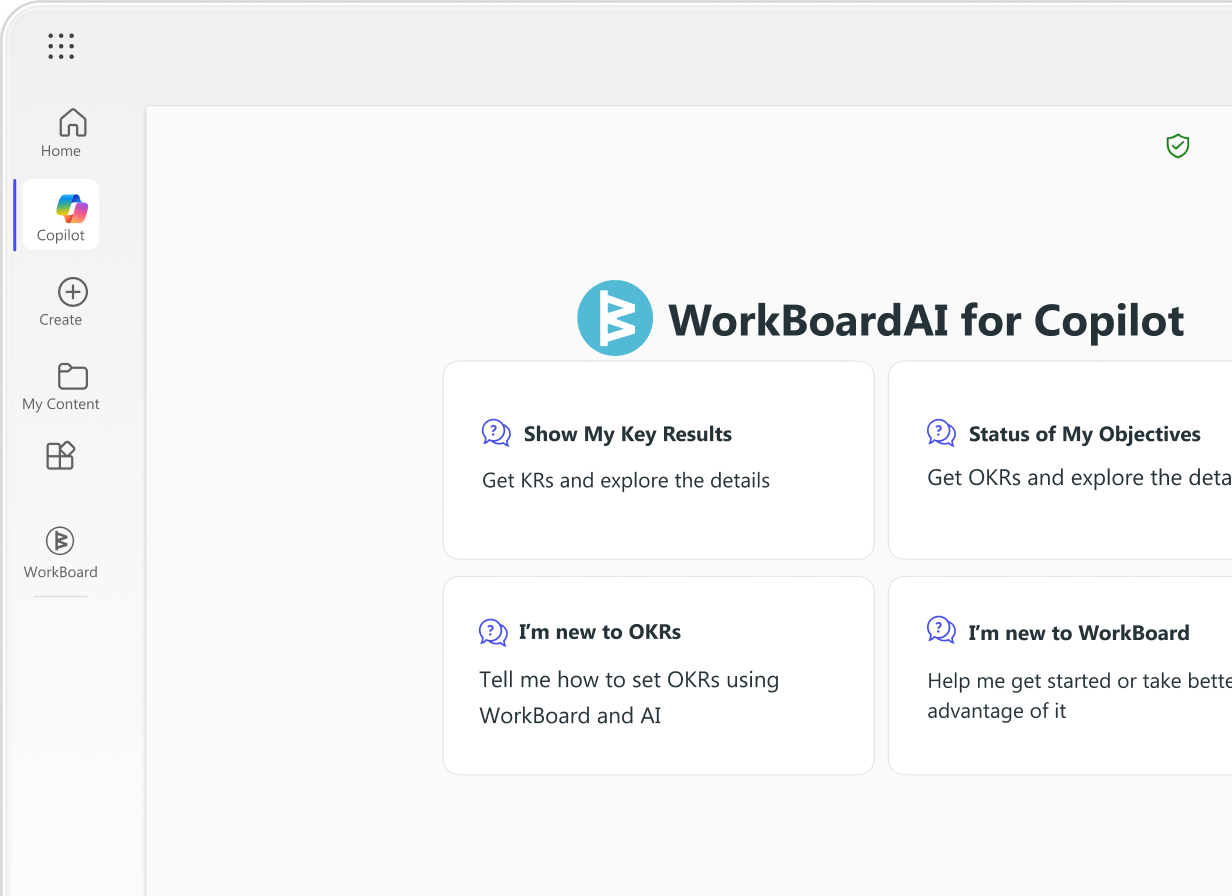
A platform like WorkBoardAI aligns all of it so every team operates from the same facts and focuses on the outcomes that matter most. It gives the revenue engine a single view of objectives, key results, risks, and progress. It streamlines operating rhythms so MBRs, weekly meetings, and one-on-ones actually drive decisions instead of reporting on past events. It reduces the manual work leaders rely on today and gives them early signals to coach, course-correct, and move faster. When teams work from one system of record, execution becomes consistent, transparent, and predictable.
Manage OKRs with WorkBoardAI
WorkBoardAI gives you the system with AI agents and AI-powered processes to align your teams, focus execution, and accelerate the outcomes your strategy depends on. It brings clarity to what matters now, makes progress transparent, and strengthens the accountability and operating rhythm you need to move faster with confidence. If you’re ready to raise the velocity of your revenue organization and de-risk the next few quarters, now is the moment to see it in action.
Book a demo and see how it can elevate your execution in the most effective way.