Article Overview
Organizations depend on alignment to achieve their strategy, deliver value, and create an environment where people can do their best work. Yet alignment is fragile. It breaks down at the strategic level, across functions, and between managers and team members. When alignment is unclear or inconsistent, progress stalls, accountability weakens, and careers drift off course.
This guide brings together two essential perspectives on alignment. We start at the individual and managerial level — where expectations and outcomes are often misaligned — and expand to the organizational structures, behaviors, and systems needed to create true strategic alignment at scale.
Strategic goal alignment: Job one for managers
Two days before Yolanda’s performance review, she sent a 26-page PowerPoint deck intended to summarize her accomplishments for the year. She’d clearly spent hours on the deck, perhaps more than a day packaging and positioning accomplishments. She’d even asked four colleagues to write emails lobbying for her promotion. Although she’d only been on my marketing and strategy team for 18 months, Yolanda had been in the same role at the same level for more than 5 years.
In her mind, this was her year to get ranked at the top of the team and get promoted — the performance model at the company. The 26 pages of presentation and emails were intended to seal the deal.
The goal to get promoted had become the one and only goal.
Her promotion goals eclipsed Yolanda's efforts to achieve her group's goals or add value to the organization. Her focus became skewed to getting her contributions “on the record” rather than making great contributions — often consuming team time and draining rather than adding value in the process.
Inevitably, she did not rank among the highest performers on the team. She’d forgotten that career rewards come as a result of value creation and goal achievement, not time in job, positioning and lobbying.
Achievement is the fastest path to advancement
While I respected Yolanda's desire to advance her career, she would have been better off investing her energy in four key disciplines rather than on self promotion and her outcome at the expense of the organization’s:
1. Align goals up, break them down to actions
Make sure you understand the strategic and economic objectives of the organization and the specific objectives and key results (OKRs) for your team. Work with your manager to set ambitious, measurable OKRs that align upward and have real impact; break them down into actionable elements and defined tactics for each quarter and month.
2. Know your progress against objectives
Time flies, as the saying goes. Work the list of actions that achieve the defined OKRs and do a weekly check point on your progress. You own your achievements; don’t rely on others to ensure you get there.
3. Focus on value creation
Have an unwavering focus on creating value for customers and the organization above all else. Work with this as your genuine purpose every day. Take a minute to assess your commitment to value creation and whether it calibrates with the career success you’d like.
4. Let results do the talking
Deliver what you committed and then some. If you achieve and exceed measurable OKRs consistently, you create real value for the organization. Results like that speak for themselves and for you.
Alignment and accountability are the leader's job
As Yolanda’s manager, I fell short too. Like many managers according to Harvard Business Review, I avoided hard accountability discussions. I could have helped her be more successful for our team and in her career aspirations over the course of the year by being more consistent in four key areas of management:
1. Keep OKRs and priorities visible
To make it easier for Yolanda and others to stay aligned with the team’s goals, I should have kept specific, measurable OKRs and status of their achievement more consistently visible to the team. Beginning and end of quarter aren’t sufficient in organizations with tens of thousands of people and millions of emails.
2. Track actions and have clear ownership for each deliverable
To avoid confusion about responsibilities and ensure OKR achievement, I should have over communicated expectations and ownership of deliverables. The clarity on actions reinforces what to focus on and provides an accomplishment roster at year end.
3. Use regular status reports to assess progress and create feedback opportunities
By getting a regular status update on the specific actions and deliverables required to achieve OKRs, both Yolanda and I would have the same fact base on her results and impact. This creates a specific trigger to note great progress, identify performance gaps on deliverables for goal achievement and establishes strong follow through in the 50 weeks between goal setting and performance review.
4. Give more continuous feedback
By providing more regular and specific feedback on work product, I could have reduce the gap between Yolanda’s perception and her actual execution. It’s natural to want to avoid difficult conversations but performance conversations just get more difficult with time. Feedback tied to the work product and actions needed to achieve defined goals is essential throughout the year.
These are fairly obvious best practices but difficult to sustain in complex organizations, particularly with the global teams and travel complexities I had at the time. It is incredibly time consuming to compile and communicate the performance fact base and my days were already three time zones long. Email archiving and fractured productivity tools made matters worse by breaking the business narrative into a thousand tiny pieces (lists of deliverables in Excel, dashboards in PowerPoint, endless document revisions in SharePoint and the discussion of status and quality in email and email archives). Without transparency and management efficiency, accountability is hard to achieve on a distributed team.
Recalibrate now for this quarter
The human and business cost of goal and expectation gaps are high. Commit to transparency, accountability and achievement as fundamentals in your management model and sustain them in practice. Recalibrate with team members to make sure goals are well understood, close gaps in execution or expectations, and give course-correcting or rewarding feedback where needed. Your performance and your team's will go up — you and your Yolanda will be happier!
What are your lessons learned on execution and expectation gaps? Do my mis-steps as a manager sound familiar?
Organizational alignment: The enterprise lens
While misalignment between managers and team members creates immediate friction, it often reflects a larger structural issue: the organization itself isn’t aligned. When strategy, goals, and execution are not connected across functions, teams operate at cross purposes, decisions slow down, and people lose sight of the value they are supposed to create.
Organizational alignment ensures that every team, function, and individual moves in the same direction with clear purpose. When alignment is strong, accountability is easier, outcomes improve, and teams execute with confidence. When alignment is weak, the entire operating rhythm breaks down.
What organizational alignment really means
Organizational alignment is the discipline of coordinating strategy, resources, and day-to-day work toward a shared set of outcomes. True alignment requires both:
- Vertical alignment — strategy → business units → teams → individuals
- Horizontal alignment — cross-functional collaboration and shared dependencies
Most organizations focus heavily on vertical cascades, but that only solves half the problem. Alignment becomes durable only when teams can see across functions, understand how their work connects, and operate with transparency.
Why org-wide alignment matters
Strong alignment drives five essential benefits:
- Clarity and accountability — people know what matters and why
- Better decision-making — teams act with shared context
- Higher engagement — people see how their work creates value
- Faster collaboration — fewer bottlenecks and silos
- Greater focus — time and resources converge where they matter most
Alignment is not a one-time exercise. It is a continuous management discipline.
How to build alignment across the organization
Effective alignment requires a set of coordinated practices that work together across the business. These five steps create a durable alignment system:
1. Establish strategic clarity at the top
Executives must align on the company’s strategic priorities and long-range outcomes. Without a shared, explicit strategy, teams anchor to assumptions — not clarity.
OKRs help express strategy as measurable outcomes, so teams know what the organization is aiming to achieve now.
2. Communicate the North Star clearly and consistently
Once leaders align, the strategy must be articulated in plain language. Employees need to understand:
- What the company is trying to achieve
- Why it matters
- How their work contributes
Clarity reduces resistance, builds engagement, and shortens the time to alignment.
3. Build structures that support alignment
Alignment requires a system that connects teams both vertically and horizontally. This often looks like:
- Matrix communication flows
- Shared cross-functional objectives
- Joint ownership of outcomes
When teams only look upward, misalignment grows sideways.
4. Ensure transparency at every level
Visibility into goals, progress, risks, and dependencies is essential. Transparency creates:
- Faster issue identification
- Higher-quality conversations
- Better decision-making
- Stronger trust
People cannot align around what they cannot see.
5. Sustain alignment with feedback and cadence
Alignment decays without ongoing management. Regular check-ins, retrospectives, and progress reviews keep teams synced and allow quick correction when priorities shift.
Alignment is not an annual conversation — it is a weekly and quarterly rhythm.
From manager-level alignment to full org alignment
When we combine the micro-level alignment issues illustrated in Yolanda’s story with the macro-level alignment structures outlined above, a full picture emerges:
- Managers need clear goals, visible progress, and consistent and candid feedback.
- Teams need strategic clarity, connected objectives, and shared accountabilities.
- Organizations need alignment structures, communication rhythms, and transparency that link strategy to execution.
Alignment is the single leader’s job. But not only. When a company wants to be successful and growing, alignment should be everyone’s job, supported by a clear operating rhythm and shared expectations for outcomes.
To build organizations that execute strategy with speed and confidence, alignment must be intentional, structured, and continuously reinforced.
How WorkBoardAI help you build alignment at scale
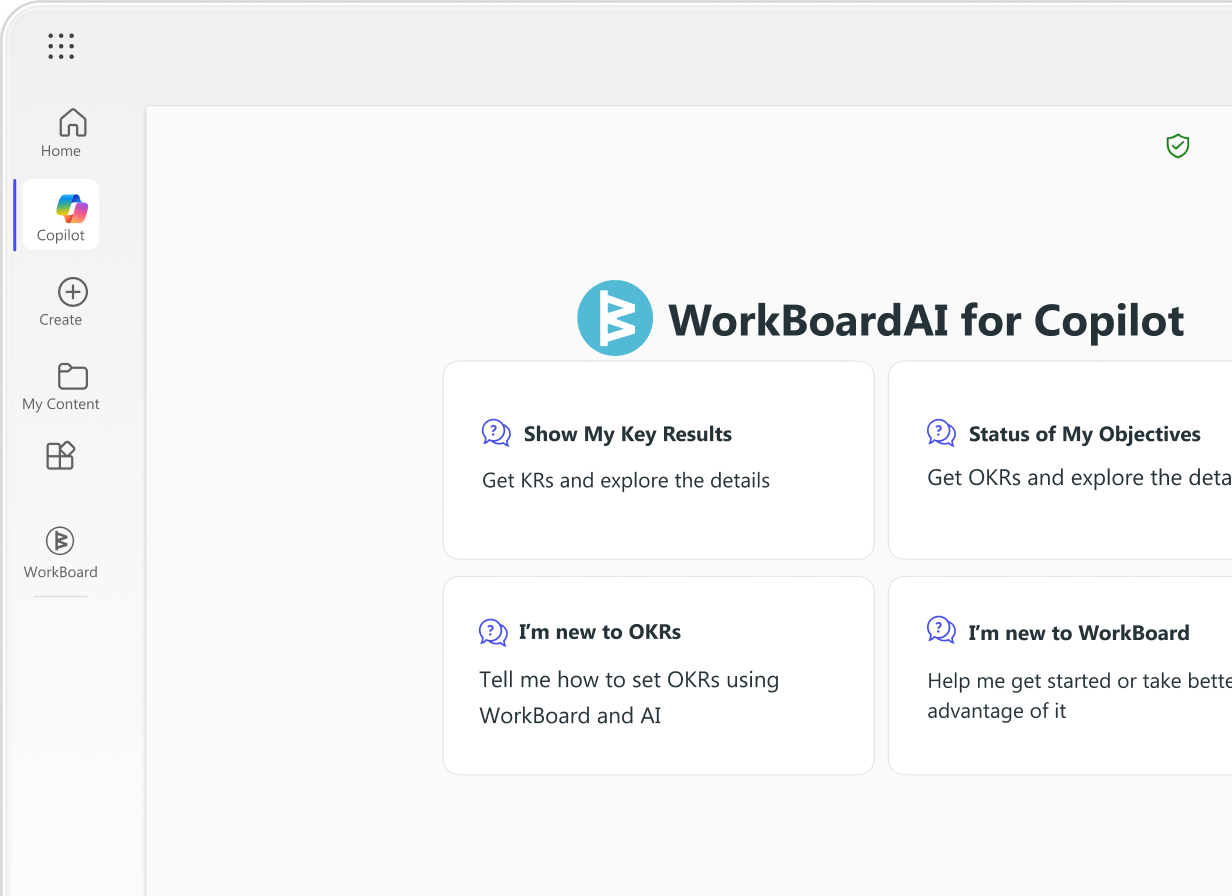
WorkBoardAI strengthens your operational rhythm by bringing goals, strategic progress, risks, and outcomes into a single, radically transparent system. Instead of searching for information, stitching together status updates, or relying on anecdotal signals, leaders and teams can operate with a shared fact base that drives better decisions and better results.
AI Agents accelerate alignment by doing the work that clutters management capacity. They surface risks in OKRs and scorecards, prepare business review materials in minutes, summarize weekly progress signals, and help managers run 1on1s with clearer context. They also coach leaders and teams on next steps, nudging people toward the outcomes that matter now. When AI strengthens the operating rhythm, leaders regain time for judgment, coaching, clarity, and communication.
Learn more about WorkBoardAI.