Article Overview
Vertical AI agents are quickly becoming an essential part of how organizations operate. What seemed experimental a few years ago is now a practical way for leaders to extend their teams with AI that takes on real operational lift and reinforces the work that matters most every week.
Understanding vertical AI agents
Vertical AI agents are specialized digital team members for a specific industry or function. They speak the language of that work area, understand its workflows and constraints, and use that context to automate high-value tasks with precision. They work with the data that already drives your business, integrate with the systems you rely on, and help teams move from insight to action with far less manual effort.
Their strength is focus. In environments where accuracy, compliance, and established processes matter, vertical AI agents raise execution quality. They cut repetitive work, keep attention on mission-critical outcomes, and improve decision quality with timely, trusted information. They aren’t meant to do everything — they’re designed to excel in the space that matters most to you.
Examples of vertical AI agents
1. Healthcare: Medical imaging review agent
AI agents trained on radiology data analyze CT scans, MRIs, and X-rays, flag anomalies, and draft preliminary findings for clinician review. They reduce interpretation time, improve early detection, and streamline diagnostic workflows in systems where accuracy and compliance are essential.
2. Financial services: AML and compliance agent
Banks use vertical AI agents that monitor transactions, detect suspicious patterns, and prepare compliance reports. These agents understand regulatory rules, industry terminology, and risk models and help teams meet audit standards with greater consistency and less manual review.
3. Strategy execution: WorkBoardAI Chief of Staff and Leadership Coach
WorkBoard's AI agents are vertical digital experts for strategy execution. They prepare leaders for reviews and 1-on-1s, surface execution risks, assess goal (OKR) health, summarize strategic progress, and improve coaching quality of managers. Because they operate inside the strategy execution system of record, they provide context-rich insights that strengthen alignment, accountability, and execution velocity across the organization.
AI Agents for strategy execution
WorkBoardAI agents focus entirely on alignment, accountability, and high-velocity execution. They strengthen the golden thread from strategy to weekly work and help leaders run a more effective operating rhythm. They are built on WorkBoard’s strategy execution system and pull data from all connected integrations (following security standards), which gives them the full strategic context to help at every level of the organization.
WorkBoardAI agents help leaders:
- See team and cross-team alignment, strategic progress, and execution risks in real time
- Prepare for business reviews, weekly team meetings, and 1-on-1s with high-impact agenda
- Reduce time spent searching for information, data and insights
- Improve coaching and feedback for managers and teams
- Create a single view of goals, tasks and projects, risks, and dependencies
When agents take on routine tasks, people managers spend more time driving outcomes, not navigating platforms. AI agents surface early signals, so teams avoid late surprises and course-correct faster.
The two primary WorkBoardAI agents are the AI Chief of Staff and the AI Leadership Coach. Each supports a different aspect of the operating rhythm.
AI Chief of Staff
Strengthens alignment, visibility, and execution cadence.

The AI Chief of Staff helps managers and executives run a more consistent, data-driven business rhythm. It taps into connected data sources and brings together strategy, goals (OKRs), tasks and projects, meetings and risks so leaders always know what needs attention and how teams are progressing towards the company strategy.
How the AI Chief of Staff supports first-line managers:
- Helps brainstorm and create team goals that connect with the company strategy
- Reminds goal owners to update their results and highlights late or never-updated items
- Prepare weekly overviews on progress, risks, and commitments
- Present each person’s overdue actions and progress trends
- Send targeted nudges that improve follow-through and accountability
Let's pretend you have a product team lead. He's responsible for creating quarterly goals with five engineers but struggles to keep those goals aligned and current to the strategy. The AI Chief of Staff helps the team lead draft clear goals that connect directly to the company’s strategic priorities, ensuring each engineer’s work connects to the team’s objectives. Throughout the quarter, it reminds goal owners to update their results, flags goals that have gone stale, and highlights where due dates are at risk.
The AI Chief of Staff helps first-line managers stay focused on leading and solving problems by taking on the update chasing and administrative work needed to keep goals clear, current, and aligned.
How it supports managers of managers:
- Rolls up progress across teams for a single view of execution health
- Highlights misalignment where goals don't ladder to parent outcomes
- Prepares pre-reads for staff meetings and QBRs with trends and questions for discussion
- Surfaces cross-team dependencies with resolution owners and dates
- Shows which teams update goal results reliably and where coaching is needed because update discipline is low
With the AI Chief of Staff managers of managers can calibrate attention and coaching where it will have the most impact.
For example, a Director of Sales Operations oversees three regions with uneven goal practices. The AI Chief of Staff gives the director a single aligned view of all teams’ goals, flags where goals don’t connect to company priorities, and highlights two dependencies that are delaying progress. It also shows which teams routinely miss updates. The director uses this snapshot to recalibrate goals quickly and tighten update discipline across regions.
How it supports executives:
- Provides a concise view of top goals and leading indicators
- Confirms the quality and measurability of critical goal results
- Summarizes what is on track, off track, and the key decisions needed
- Shows where capacity is consumed without advancing strategy
- Produces summaries ready for board, investor, or ELT conversations
For example, the Chief Product Officer is preparing for the ELT review and needs a fast, accurate read on goal progress. The AI Chief of Staff pulls live data on enterprise objectives, shows which results are slipping, and exposes where effort is high but impact is low. It drafts a crisp summary of what is on track, what is at risk, and the decisions needed. The CPO enters the meeting with a clean narrative anchored in current execution, not manual reporting which started weeks before the ELT review.
Examples of what leaders can ask:
- “Prepare a meeting pre-read for my staff meeting.”
- “Show at-risk goal results across my teams.”
- “Nudge owners with overdue updates.”
- “Create a scorecard for this quarter’s critical strategic outcomes.”
- “Summarize progress vs goal targets and propose next steps.”
The AI Chief of Staff turns fragmented information into a structured, actionable operating rhythm that reinforces strategy execution.
AI Leadership Coach
Improves managerial effectiveness, clarity, and coaching quality.
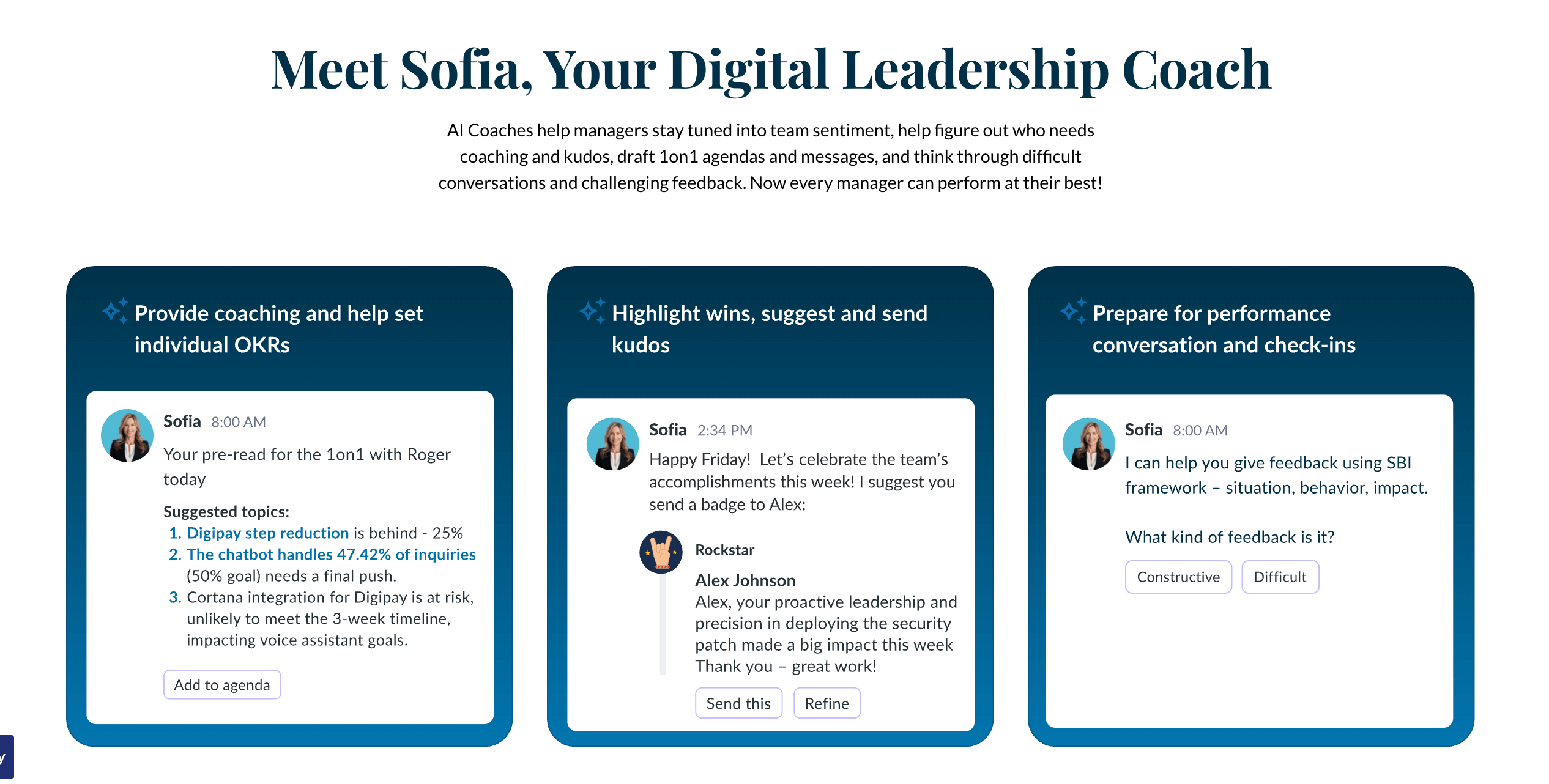
The AI Leadership Coach focuses on helping people managers operate with clarity, give constructive feedback, and drive better outcomes with their teams. It strengthens core leadership habits across the entire org.
How the Leadership Coach supports first-line managers:
- Generates weekly summaries of each direct report’s achievements, risks, and blockers
- Turns notes into clear, constructive feedback using the situation–behavior–impact (SBI) structure
- Provides guidance on delegation, workload balance, recognition, and performance gaps
- Helps plan and communicate organizational changes
- Supports conflict resolution and expectation resets
Let's say there's a technical support team lead in your company who's preparing for weekly 1-on-1s with five direct reports. Before each meeting he may be piecing together updates from Slack, spreadsheets, and emails - or worse, asking their direct reports to send them status updates weekly. Instead, the AI leadership coach generates a concise summary of each person’s wins, risks, and blockers. The team lead sees their set targets are slipping due to a dependency that has not been escalated. The manager goes into the conversation ready to address the risk, reset expectations, and clarify ownership. This is just one example how this week’s critical issue can be surfaced early and resolved quickly with the help of AI.
How it supports managers of managers:
- Prepares consolidated summaries on how each team is doing
- Curates scorecards for business reviews
- Rolls up at-risk areas and dependency issues
- Tracks confidence patterns across teams
- Strengthens leadership systems and delegation norms
In your organization you may have a director overseeing three product teams. He's heading into a monthly business review. The leadership coach can provide a consolidated summary of progress across all teams he manage, highlighting a dependency between Team A and Team C that is putting a launch milestone at risk. The coach also creates a scorecard showing confidence trends and overdue actions. With this view, the director can address the cross-team breakdown directly, assign a resolution owner, and focus the review on decisions rather than status reporting. When risks are spot at the moment they arise, meetings turn into a productive problem-solving sessions.
How it supports executives:
- Provides visibility on enterprise OKRs and where value is created or at risk
- Surfaces systemic risks and cross-functional delays
- Prepares business review materials with live data
- Diagnoses alignment issues and guide recalibration
- Supports executive communication and narrative clarity
Every executive needs to prepare for quarterly strategy reviews. The leadership coach can pull live data on enterprise OKRs, surface where value creation is strong, and highlights systemic delays in XYZ cross-functional initiatives that threaten quarterly outcomes. It drafts a narrative that explains what is on track, what is at risk, and the three decisions needed from other executives (for example the CEO and the CFO). This shifts the review to a clear, data-backed conversation about execution progress and trade-offs.
Examples leaders can use right now:
- “Prepare for a 1-on-1 with my direct report.”
- “Assess my progress for last week.”
- “Help me frame feedback for a missed deadline.”
- “Show my at-risk goal results.”
- “List goal progress and help me update them.”
- “What should I focus on this week.”
- “Be my thought partner on a team conflict.”
The Leadership Coach builds stronger leaders by reinforcing clarity, feedback, focus, and feedback on the work that drives strategic outcomes.
Why AI agents matter in strategy execution?
The cost of inaction on improving strategy execution is far higher than any investment you make. When clarity, alignment, and accountability lag, organizations lose enormous capacity because teams don't understand the strategy or how to contribute. Operating rhythms become expensive and ineffective, with leaders spending millions of dollars and thousands of hours on surfacing issues too late to act on.
AI agents fix this. They are proactive and understand your business context. They see things that go unnoticed within the pool of information and data.
“Without WorkBoardAI, I wouldn’t have the ability to respond to internal and external changes quickly – I wouldn’t run the business without it.” – Tina Murphy, President, GHX
“I can't wait for when we’re going to be able to upload our brand book into WorkBoard and have the AI agents talk to us like they are Metropolis.” – Allison Kinney, Metropolis
“In WorkBoard, the agents have a superpower… it has the context of who you are and your business. ChatGPT and Copilot don’t have that context.” – Sameera Moinpour, WorkBoard
WorkBoardAI agents improve strategy execution by ensuring leaders and teams:
- Operate with a shared view of objectives, key results, and risks
- Use each meeting to drive outcomes, not discuss status
- Coach and course-correct with data instead of 'gut feeling'
- Reduce wasted effort in preparation, reporting, and alignment
- Move faster with less friction across functions
- Reinforce the golden thread between strategy and weekly execution
When clarity improves, alignment improves. When alignment improves, accountability becomes natural. When accountability becomes habitual, execution accelerates.
WorkBoardAI agents make this cycle stronger and more reliable across the entire organization.
Book a demo to see them in action.