Article Overview
Organizations adopt OKRs because they want clarity, alignment, focus, and the momentum that comes from working toward outcomes that truly matter. But writing great OKRs — ones that motivate teams, clarify what success looks like, and align execution with strategy — requires more than simply filling out a template.
It requires first principles, a clear structure, and a practical, repeatable process that teams can use every quarter. And with WorkBoardAI, it also becomes dramatically faster, more collaborative, and more fun.
Let’s start with the foundation.
OKRs first principles
Using OKRs to align and achieve your best outcomes is quickly becoming a strategy execution norm... but OKRs are not MBOs and KPIs with another name. Rather than simply measuring operational metrics or individual performance, OKRs provide a common vocabulary and quarterly process for organizations and teams to articulate and align what they want to achieve, focus efforts on measurable outcomes, and iteratively learn with data over time.
Here are my first principles for success with OKRs:
1. Aim for great
Instead of target results that are the safest or most certain outcomes, define the best possible results. By defining them, you resource and prioritize them.
2. It's a team sport
OKRs are set by and for teams, rather than defined by managers and assigned to team members. Team authorship leads to higher ownership and stronger inclusion of diverse perspectives.
3. Fast pace
OKRs are set quarterly. When teams define best outcomes in 90 days, time is a constraint to sharpen priorities and trade offs. Every 90 days, there is an opportunity to assess what's changed and learn from what's achieved; it creates agility and adaptability.
4. Drive with headlights
Instead of end of period measures that give you signal when it’s too late, key results shine a bright light on the ground in front of you so you can navigate well.
5. Leverage
The 3 hours teams spend defining objectives and key results they want to achieve in the next 90 days ensure everyone's time is well spent and high impact. The strategy executed is the sum of everyone's weekly choices; setting OKRs ensures those choices are strategic.
6. Global and local
Instead of top down or bottom up, OKRs are localized by teams into their nouns, verbs and numbers with global coherence and alignment. They can be set asynchronously and reconciled rather than in a sequential cascade.
3 steps to writing OKRs with clarity and transparency
Now that the principles are clear, the next layer is writing OKRs in a way that brings those principles to life. High-quality OKRs:
- Create a shared sense of direction
- Make priorities unambiguous
- Define measurable success
- Enable alignment across teams and time zones
- Make the work of the quarter transparent
Clarity is not nice to have — it is central to execution.
Unclear OKRs lead to unclear weeks, unclear decisions, and unclear outcomes.
Step 1: Know what a good OKR structure looks like
A strong OKR has two components:
The objective is short, qualitative, inspiring statement of what we intend to achieve.
Should be:
- Aspirational
- Memorable
- Aligned to strategy
- Emotionally motivating
Key results are a small set (2–4) of quantitative, time-bound indicators of what success looks like.
Should be:
- Measurable
- Outcome-based
- Specific and numeric
- Indicators of progress, not activities
Formula:
We will (Objective)… as measured by (Key Results).
Step 2: Writing great objectives
Great objectives make people want to achieve them. They capture intent, ambition, and purpose in a way that energizes the team. When drafting objectives, ask:
- Why does this matter?
- What meaningful outcome will this drive?
- Would this motivate me if I joined the team today?
Keep objectives short — if the team can’t remember them, they won’t deliver them.
Step 3: Writing strong key results
Key results define what success looks like in terms everyone can see and measure. They must be numeric or otherwise, no one knows what “good” looks like.
Characteristics of strong KRs:
- “From X to Y” framing
- Direct line of sight to the objective
- No list of tasks or activities
- No ambiguity
If there’s no number, it’s not a key result.
Want to see OKR examples for all company levels and functions? Check this complete list of OKR examples.
8 common writing mistakes to avoid
Even well-intentioned teams fall into predictable traps:
- Too many priorities
- Writing tasks instead of outcomes
- Setting unrealistic or trivial goals
- Using vague language
- Forgetting to adjust when conditions change
- Creating OKRs without the team
- Cascading OKRs mechanically
- Confusing KPIs with KRs
These mistakes slow the organization down and sometimes for an entire quarter. Avoiding them dramatically speeds alignment and execution.
Check this holistic list of OKR mistakes to avoid.
Setting OKRs with WorkBoardAI Co-Author
OKRs provide a common vocabulary for defining intentions (the objective) and how success will be measured (the key results), and they clarify accountability for measuring and driving those results over the quarter. Clarity on outcomes is the key ingredient for accountability and achievement.
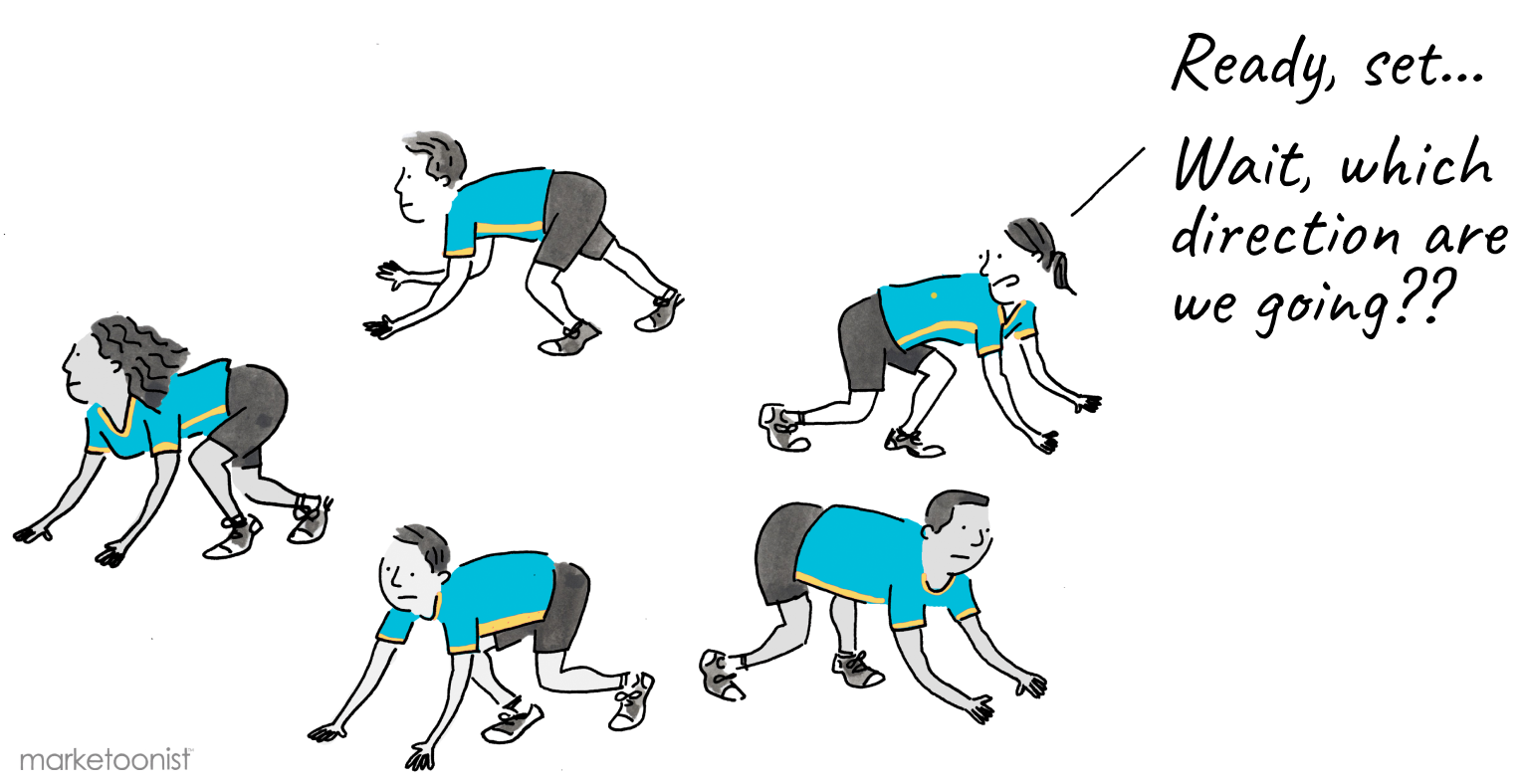
While it can seem like a waste of time to discuss objectives and key results at quarter start, it really ensures that the 530 hours every member of the team has in the quarter isn’t wasted on the wrong work or outcomes. Real alignment beats hidden assumptions every time! For cross functional efforts, agreeing on how the group wins together is key to winning at all.
The 3 steps below make aligning on outcomes fast, fun and fruitful for your team.
1. Use OKR Canvas to gather input ahead of the OKR conversation
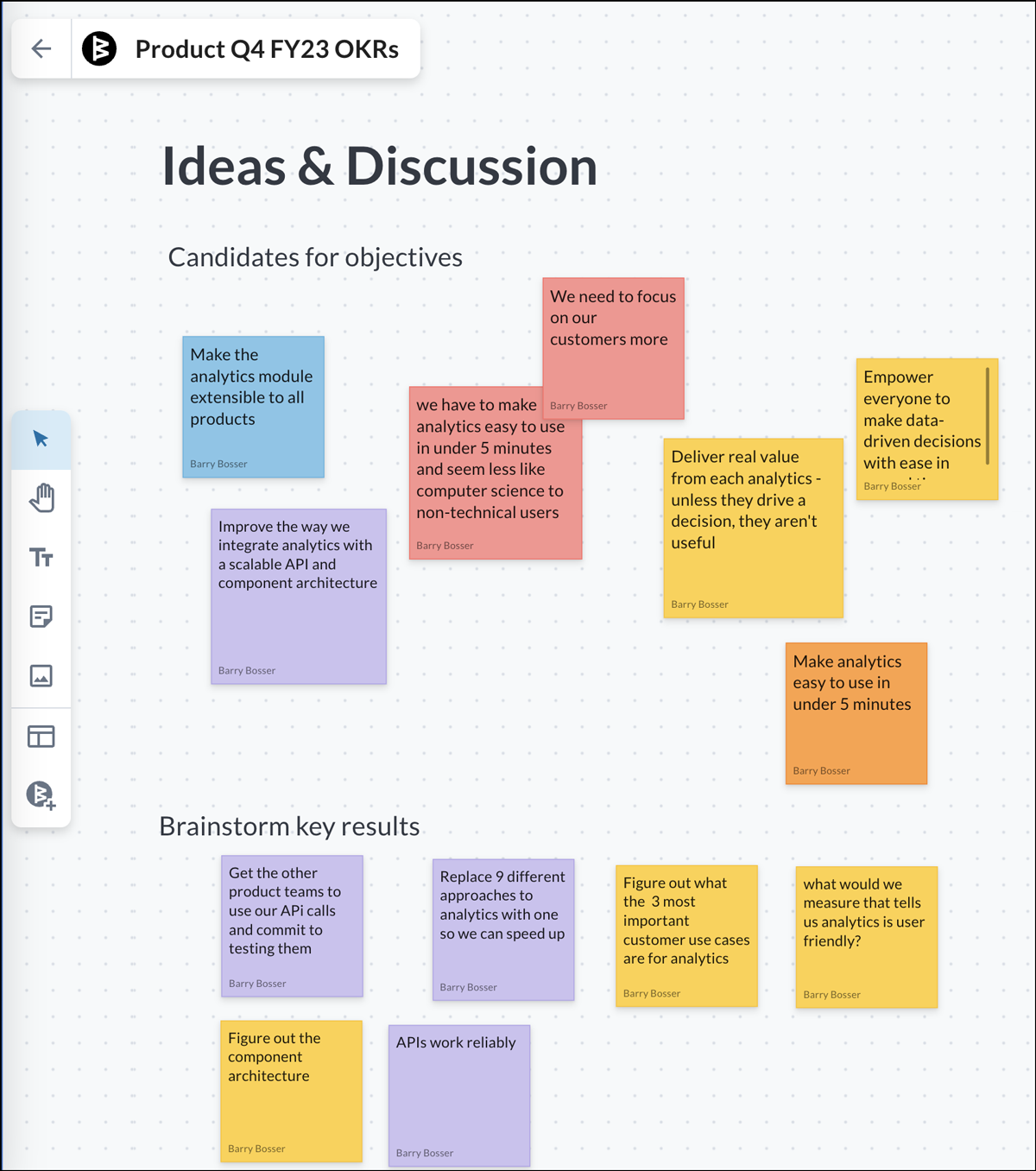
Set the stage. Add your thoughts on what objectives and results might be. Bring other OKRs onto the Canvas as a reference.
Source ideas in advance. Give people time to think and gather their thoughts ahead of time so the conversation doesn’t wander.
Give the team a timeline. Give people and few days head of the conversation time but give them a firm deadline to both provide comments and read other people’s.
2. Use Co-Author to quickly generate draft objectives and results
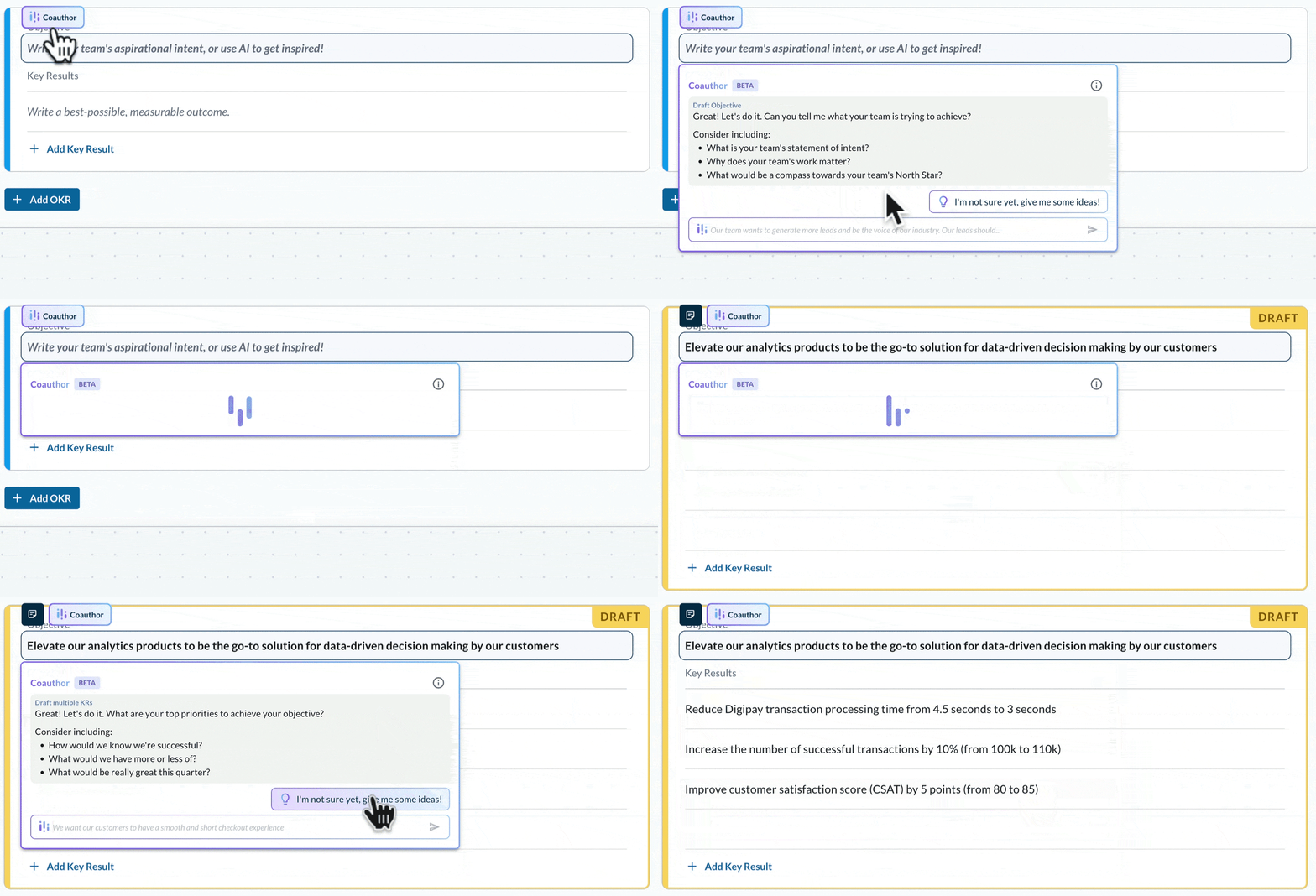
Get to first draft fast. Using the team’s conversation and ideas, use WorkBoard OKR Co-Author to draft an objective from a raw idea. Click into the objective field, add basic direction and ask co-author to suggest an objective. It takes about 5 minutes – not 50 minutes – to iterate until it hits the mark!
Draft good Key Results quickly. Use your conversation notes to set your key results or ask Co-Author to refine your input into measurable key results. In seconds, Co-Author can make it shorter, more specific, more measurable and so on – you don’t have to be an expert to get to great OKRs quickly.
3. Tie Off and Publish your Objectives and Key Results
Publish when you’re ready. Leave your OKRs on the canvas and socialize with others before you publish – it will stay in draft until you’re ready to publish. Invite others to your canvas and encourage them to leave notes where they have input or suggestions.
Decide whose buy in you need. Make 20 minutes to discuss team OKRs with other teams upon which you depend or to whom you deliver outcomes; get a firm handshake on shared understanding.
It’s go time. Click publish to post your OKRs so others can see them, and your team can measure and drive progress to the results you aligned on.
We should talk
There is nothing less effective than spending a quarter doing the wrong work; agreeing at the outset of the quarter how success is defined and measured enables everyone to work autonomously toward the right results over the quarter. Finding the right balance of constructive debate and decision making is not easy – but teams improve at it with practice and the most successful teams have nailed it.
Remember, by discussing key results every two weeks, teams quickly find and adjust key results that weren’t quite right, and can capture what they’ve learned, refine key results and improve their impact each quarter. Have a healthy discussion without getting stuck – this is an agile, iterative process for focusing everyone’s efforts on shared outcomes!
When teams spend less time struggling with wording, versioning, or alignment, they spend more time achieving extraordinary outcomes.