Article Overview
To realize the results-accelerating effects of OKRs, the leadership team and employees need to build new muscle and invest in changing habits. OKRs are an operating rhythm, an operational cycle and an ongoing process. Like all new things, it takes time, effort and commitment and you can improve every quarter.
The 5 most common OKR pitfalls
1. Set and forget
Although people adopt OKRs because they want to drive better results, the biggest mistake is setting and forgetting OKRs at the start of each quarter. Leaders never bring them into staff meetings and business reviews; teams leave their OKR session excited and then returns to habitual work, recurring meetings, their mail and chat which consume all their time and focus for the quarter. End of quarter, everyone recognizes they failed to mobilize – and failure was optional. [See how Microsoft drives operational focus to achieve its best results.]
2. Check the box
Similar to set-and-forget, some teams focus on getting OKRs “done” rather than defining great results they are motivated to drive in the quarter. Everyone has OKRs but no one cares.
3. No validation
The OKR shines a light on aligned outcomes, so it’s crucial to have tie off conversations between adjacent teams and teams and their next-level leadership. A clean handshake ensures everyone’s time is well spent in the quarter and the whole is greater than the sum of the parts. Finding misalignment mid-quarter is a failure of leadership and of the team’s good will.
4. Confusing actions with results of actions
While executives may naturally think in terms of metrics and results, front line teams may not have experience defining results and outcomes of their work. Quantifying results isn’t a natural exercise, and it often requires facilitation the first and second quarter – the business equivalent of a yoga teacher! Once the organization has the experience to define and drive results, it will do amazing things. Without the coaching, OKRs will quickly become tasks lists – duplicative effort that doesn’t add results velocity. [Check out this seminar on Outcome Mindset™ for more.]
“OKR coaches are critical to the whole journey.”
—Emily Bruzzone, Office of the COO, Workday
5. Burying OKRs
You and your OKRs need to be present to win. Their greatest power is helping teams focus precious time, but when they’re out of sight they’re also out of mind. The best results come from weekly attention to KRs, the gaps and risks to team outcomes, and inter-team results dependencies – results management platforms give teams the power and the data to do their best. [See how Workday brings its OKRs into focus.]
Structural OKR mistakes that undermine alignment and execution
Beyond the common behavioral pitfalls, organizations also stumble on deeper structural, cultural, and operational gaps. These mistakes slow momentum, dilute clarity, and limit strategic focus. Below are the most frequent — and avoidable — errors teams encounter as they scale OKRs.
1. Goal-Setting & Strategy Errors
Misunderstanding OKR components
When objectives become tasks or key results become activities, the system collapses. Objectives should describe the intended outcome; key results should quantify progress toward it. Mixing the two produces confusion and weakens focus.
Too many objectives
OKRs require prioritization. When teams define six or seven objectives, they dilute their efforts and create noise rather than clarity. Great strategy is a set of choices — and OKRs require the same discipline.
Stretch vs. unrealistic goals
Ambition matters, but delusion does not. Unrealistic OKRs demoralize teams and erode trust; trivial OKRs waste a quarter. The right balance pushes the team beyond business-as-usual without breaking execution capacity.
Confusing KPIs with OKRs
KPIs measure health; OKRs mobilize progress. Treating KPIs as OKRs locks teams into maintenance mode instead of forward motion.
Using the wrong cadence
Annual OKRs can’t adapt to a changing environment. Quarterly OKRs — with weekly attention and monthly reviews — keep teams aligned, focused, and agile.
2. Adoption, alignment, and operating rhythm errors
Underestimating the change required
OKRs aren’t a document — they are a management discipline. Organizations fail when they assume OKRs can succeed without role modeling, communication, coaching, and weekly engagement.
Not involving teams in OKR creation
OKRs work best when teams co-create the outcomes they own. Top-down mandates often miss execution realities and reduce ownership.
Department-level misalignment
No team achieves strategic outcomes alone. When sales, marketing, product, customer success, and operations define conflicting OKRs, friction accelerates and outcomes stall.
Lack of transparency
Organizations falter when teams lack visibility into dependencies, risks, and progress. Transparency is foundational for alignment, accountability, and focus.
3. Cultural and learning Errors
Overcomplicating OKRs
Complex templates, heavy approval processes, and too many layers make OKRs fragile and slow. Simplicity accelerates adoption and builds good habits.
Blaming the method
When OKRs fail, the root cause is almost always behavior or rhythm — not the framework. Iteration, not abandonment, strengthens execution.
Not using OKRs for learning
The end of each quarter should improve the next. Retrospectives reveal where assumptions broke, where teams were stretched too thin, and where clarity was missing.
Using OKRs for micromanagement
OKRs empower teams to focus on outcomes. When leaders use them as a tool for policing activities, creativity collapses and execution slows.
The path to strong OKR discipline
When teams avoid these pitfalls — behavioral and structural — they build a sustainable operating rhythm with three essential qualities:
- Clarity on what matters now
- Alignment across functions and levels
- Accountability supported by evidence, not opinion
With that foundation, organizations drive better outcomes with far less friction and ambiguity.
How to avoid OKR mistakes with WorkBoardAI
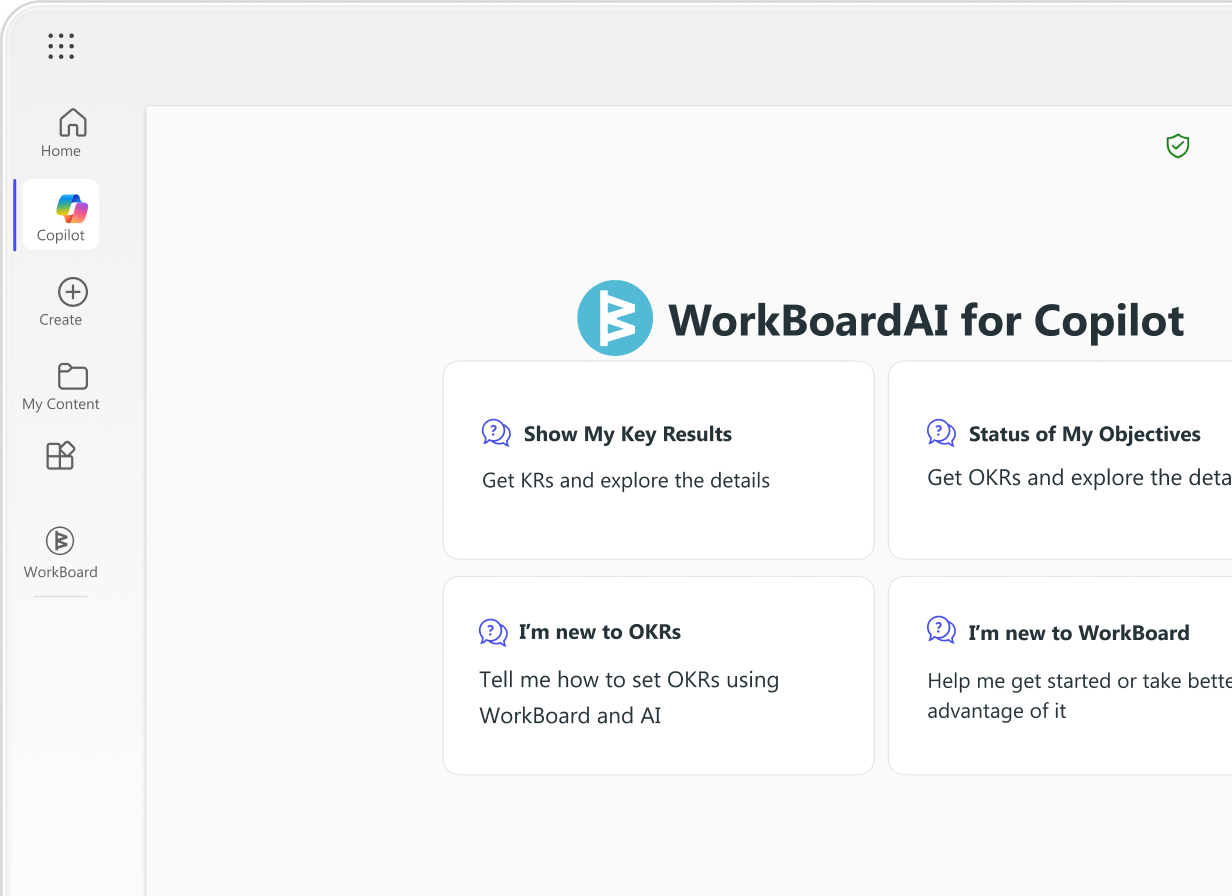
WorkBoardAI accelerates OKR creation with AI-assisted process to define clear, aligned, and high-quality objectives and key results from the start. AI Agents shorten the time it takes to draft, refine, and validate OKRs, ensuring every objective ladders up to strategy and every key result reflects measurable outcomes. They help teams cascade goals, align across functions, and expose dependency gaps so alignment is built in from the start.
Once OKRs are in motion, WorkBoardAI keeps the entire system running with far less friction. AI Agents continuously monitor progress, spotlight stalled key results, surface cross-team risks, and bring the right facts into weekly meetings and business reviews. Instead of searching for data or stitching together updates, teams stay focused on decisions, actions, and outcomes.
With WorkBoardAI, the OKR cycle becomes lighter, faster, and more disciplined and your strategy becomes achievable quarter after quarter.
Learn more about WorkBoardAI.