Article Overview
Learn what OKRs are, how they work, and why they're important for aligning on and executing the strategy within your organization.
Most organizations have bold strategies and real urgency to execute them.
But the current process to achieve the strategy is often inefficient and unprofitable, primarily due to shallow alignment, low accountability, and lack of focus on the things that matter most.
The OKR framework helps organizations tackle all three of these challenges, so everyone in the company is focused on achieving outcomes, rather than outputs, and knows exactly how their work contributes to achieving the strategy.
OKR Definition: What are Objectives & Key Results?
OKRs (acronym for “Objectives and Key Results”) are a framework that companies use to define, align, and execute on the company’s most important outcomes. OKRs are made up of two parts:
- Objectives are the ambitious goals that inspire and rally teams towards a common outcome.
- Key Results are the incremental milestones that teams use to measure progress towards achieving their ambitious Objectives.
These two parts work together: Key Results keep us on track as we navigate towards our exciting destination, the Objective. We need both parts to know where we're going and how to get there.
OKRs are a framework that give teams clarity on the most important outcomes they are trying to achieve within a given quarter and how they will measure success so resources can be concentrated where they create the highest value.
OKRs empower teams to build greater alignment, accountability, and focus — all necessary for efficient and profitable growth. When everyone knows what the strategy is and how they contribute to achieving it, people feel more connected to the company goals. OKRs cultivate a culture of employee engagement in which achieving smarter results is a team sport.
OKRs are used by some of the biggest and boldest companies across the globe, including Intel, Workday, Microsoft, VMWare, Boeing, AstraZeneca, Mercedes-Benz, Capital One, and more.
OKR Origins: How OKRs first developed at Intel & Google
Objectives and Key Results were developed by Intel CEO, Andrew Grove, in the late 1960s. With roots in Peter Drucker’s Management by Objectives (MBOs), OKRs were introduced as a framework to define and execute Intel’s ambitious goals.
One of Grove’s early students, John Doerr, went on to author Measure What Matters: How Google, Bono, and the Gates Foundation Rock the World with OKRs in 2017. Doerr later served on the board of Google, where he introduced OKRs to Google’s founders, Larry Page and Sergey Brin.
Credited with helping Google rapidly scale from a small team to over 150,000 employees, OKRs are now used by companies across industries to dynamically focus people and resources to achieve the most important and ambitious goals.
As a pioneer in OKRs, Intel sought the right Enterprise OKR Management and Strategy Execution Platform for its internal teams, and ultimately invested in WorkBoard.
What are the components of an OKR?
A single OKR consists of one Objective and multiple Key Results.
Objectives
An Objective is a statement of direction and intent, i.e., where an organization or team wants to go. Objectives are not meant to describe how the team will get there.
Characteristics of Objectives:
- Aspirational: An Objective describes an ideal future-state and should inspire and motivate people with a sense of purpose. Objectives are the lofty, aspirational goals that may seem almost impossible, but motivate teams to reach higher than ever before.
- Not Measurable: Objectives are not meant to be numerical, measurable goals - that’s what Key Results are for.
- Short or Long-Range: Depending on how lofty an Objective is, it may require months or years to achieve. Objectives may be short-term or long-term goals, lasting a single quarter, multiple quarters, or more than a year.
- 5 or Less: In an effort to focus people’s time and resources, teams should ideally have no more than 3-5 Objectives per quarter.
Key Results
Setting a lofty Objective can inspire a team to reach high and work diligently. But how do you know if you’ve successfully achieved an Objective? Key Results are the measurable outcomes that, if realized, move the associated Objective materially forward.
Characteristics of Key Results:
- Measurable: Key Results are numerical, with a target that clearly defines what it means to be complete.
- Defined Quarterly: Unlike Objectives, which may require multiple quarters or years to achieve, KRs are outcomes specifically designed to be completed within a given quarter.
- 4-6 per Objective: In an effort to focus people’s time and resources, teams should ideally have 4-6 KRs per Objective.
- Outcome-Focused: Although it can feel natural to think of Key Results as specific activities, great KRs actually describe the intended outcome achieved by completing those activities. In other words, we care more about realizing an intended outcome than simply completing a series of activities. Outcomes, not activities.
An outcome mindset helps ensure every person understands how their work contributes to achieving the company strategy. Learn more about the benefits of an Outcome Mindset Methodology.
Types of OKRs
Different types of OKRs support different strategy needs and execution horizons:
- Aspirational OKRs help teams stretch toward future-state outcomes that require new thinking.
- Committed OKRs define the specific results that must be achieved this quarter.
- Learning OKRs are useful when exploring new areas where clarity is emerging and discovery is required.
- Top-down OKRs reflect leadership’s view of strategic priorities for the next horizon.
- Bottom-up OKRs show how teams localize and advance those priorities.
- Cross-functional OKRs establish shared outcomes across teams that must coordinate to deliver results.
- Rolling or project-based OKRs support initiatives that evolve across quarters while maintaining clear intended outcomes.
These categories preserve the same underlying purpose: clarity, alignment, and ownership of results.
The OKR Cycle
The OKR cycle aligns strategy with execution rhythms:
- Annually: Clarify long-range strategic outcomes.
- Quarterly: Define OKRs that specify the results required now.
- Monthly: Inspect progress and surface risk.
- Weekly: Align on priorities, coach for performance, and adjust based on learnings.
This cadence ensures the organization moves with clarity and intent.
How to write OKRs (a connected example)
While setting OKRs, teams sometimes choose to simply capture their OKRs in static Excel spreadsheets or PowerPoint templates, many fast-moving companies are leveraging dedicated OKR software to capture their priority Objectives and measure progress to plan. Some OKR software also integrates with third-party tools including Salesforce, Microsoft Teams, and Jira, enabling teams to dynamically update KRs from external applications.
Next, let's analyze an example OKR:
Objective:
Create an employee experience that enables all teammates to achieve their fullest potential
Analysis:
- Aspirational: The Objective describes an aspirational goal that can inspire and motivate the team. Striving for an “employee experience that enables teammates to achieve their fullest potential” may sound a bit too lofty or ambiguous. That’s okay, we’ll use our KRs to get tactical.
- Not Measurable: This Objective does not attempt to define how success will be measured. Again, that’s what Key Results are for.
- Short or Long-Range: Realistically, achieving this aspirational Objective may require months or even years. This may be a consistent Objective over the next several quarters. How efficiently we achieve this Objective will be determined by how well we achieve our associated KRs.
Key Results:
- >80% of people understand our company strategy and feel confident in how their daily work contributes to achieving it.
- Participation in Employee Resource Groups increases from 7% to 15% of all employees so we build networks and relationships beyond any individual team
- <5% differential in under-represented groups for new hires and first line managers (visible to Leadership and HR only)
- <3% differential in belonging index across under-represented groups, gender, and age
Analysis:
- Measurable: Each of our Key Results is numerical, with a target that clearly defines when we have achieved success. Our team can immediately identify which results we’re working towards. High fives!
- Defined Quarterly: Although our Objective may require multiple quarters to achieve, each of our KRs describe the outcome we will work towards within the present quarter. These KRs are focused on the next 90 days, no longer than that.
- 4-6 per Objective: We have four KRs for this particular Objective. That makes it easy for us to focus our people’s time and resources on the few outcomes that matter most. Less is more!
- Outcome-Focused: Take a look at each of the KRs again. Notice that each KR describes an outcome, not an activity. Remember, a great KR clearly defines an intended result. It does not describe all the activities required to achieve that result. These KRs are all outcome-focused — awesome!
Now that you have a strong understanding of what makes a great OKR, explore OKR examples by company function.
What’s the difference between an OKR and a KPI?
OKRs are a framework for defining, aligning, and executing a company’s most important outcomes, while KPIs (Key Performance Indicators) are operating metrics used to measure and track the status of activities.
Although both are often used to communicate performance, Objectives and Key Results (OKRs) and Key Performance Indicators (KPIs) provide value in very different ways.
OKRs help facilitate discussions around what matters most in a given quarter and inherently provide context and communicate priority - i.e. OKRs communicate the company’s or team’s highest priorities and initiatives over the next 90 days, and how the company will allocate resources towards executing those priorities.
KPIs, on the other hand, communicate the progress of a given activity. A company may track dozens or hundreds of KPIs company-wide to gauge progress towards its goals.
OKRs and KPIs primarily differ in the following ways:
Objectives and Key Results (OKRs):
- Strategy Execution Framework
- 3-5 Objectives, 4-6 Key Results
- Time-bound, Quarterly
- Focus on “What” and “Why” of work
- Outcome-oriented
- Drives focus on the highest priority outcomes
- Enables vertical and lateral alignment
- OKRs localized from top-level objectives and authored by team
- Leading and lagging measures
Key Performance Indicators (KPIs):
- Operating Metrics
- 100s of measures
- On-going
- Focus on measurement of activities
- Activity-oriented
- Communicates progress against company activities - does not provide context or learnings
- (Not meant as an alignment tool)
- Typically authored and managed from top-down
- Primarily lagging measures
OKRs compared to other goal frameworks
Organizations use many goal-setting methods, but most describe goals rather than drive strategy execution.
- SMART goals help individuals define specific tasks but do not create enterprise-wide alignment.
- Balanced Scorecard documents strategy but does not guide weekly execution.
- Hoshin Kanri is strong for long-term planning but slower to adapt.
- MBOs tend to be activity-centric and often tied to compensation, which restricts ambition.
- 4DX and EOS create discipline but do not provide a full system for cross-functional alignment.
OKRs stand out by integrating strategy, alignment, and measurable outcomes into a repeatable execution system.
How do OKRs work with agile?
Although both are used to measure progress to plan, OKRs are a strategy execution framework, while Agile is a methodology used to execute iteratively on product development.
Whereas OKRs specifically measure progress towards achieving strategic objectives, Agile does not provide full-cycle visibility into how a given product drives desired business outcomes. In the Agile methodology, there is limited understanding of which Agile projects are critical to drive business value in the quarter.
OKRs, tied to business results, provide an opportunity for teams to step back, look at the bigger picture, and ask how their work contributes to achieving the company's strategy.
Compare the benefits of OKRs and Agile.
What is OKR Software?
If OKRs are the GPS system that helps you navigate towards your long-term strategy, OKR software is the technology that powers that GPS system. OKR software is your single source of truth on the progress your teams are making towards achieving your bold vision - it helps teams to align on the strategy, hold each other accountable, and focus resources on the most important priorities.
Like any new business process or system, there is no one-size-fits-all approach when selecting the right OKR software. When implementing OKRs within an organization, leaders must consider their unique company posture, current technology stack, and anticipated needs.
An excerpt from Bain & Company’s Answering Five Critical Questions Executives Ask about OKRs provides an insightful third-party perspective:
“Excel is often used for a first OKR deployment when technical requirements are comparatively low. More specialized tools list the OKRs, track progress scores and verbatims, and calculate averages of these scores, offering a visual indication of progress. Any tool should be accessible and editable by many people and serve as a single, reliable source of truth for the entire organization. For large-scale adoption, more advanced software solutions are important.”
The best OKR software integrates with your current ecosystem to ensure that the latest data from any existing repository, including tools like your CRM, DevOps Tools, or HCM, is automatically pulled into your OKR updates. Learn more about integrations.
Choosing the right OKR Software for your company
Although some teams choose to simply capture their OKRs in static Excel spreadsheets or PowerPoint slides, many fast-moving companies are leveraging dedicated OKR software to capture their priority Objectives and measure progress to plan. Some OKR software integrates with third-party tools including Salesforce, Microsoft Teams, and Jira, enabling teams to dynamically update KRs from external applications.
Ultimately, choosing the right OKR software is completely dependent upon the size and needs of your team. There are many out-of-the-box OKR solutions for SMBs that provide cost-effective repositories for housing and tracking key Objectives and associated Key Results.
On the other hand, large enterprises of more than a thousand employees often find that a more robust and dynamic solution provides greater alignment across distributed teams. A Strategy Execution Platform empowers business units to align on OKRs and reallocate significant resources to executing the most important priorities.
Bain & Company reports:
“Enterprise software provider VMware considered building its own solution but ultimately chose WorkBoard over nine others based on three strengths: its ability to be a consultative, strategic partner in designing VMware’s future; its strong platform features, capabilities, integration, and automation; and its information security and accessibility, which would promote transparency across the broader organization.
Though it’s still early in the implementation, managers report that their team members have a high level of clarity, greater focus on what’s important this quarter, and a strong understanding of how their day-to-day work contributes to the company’s broader priorities, strategy, and vision. One team, for example, has reduced the number of tools it uses by 50%, instead tapping WorkBoard to help complete projects with a measurable impact on the business, while becoming more proactive and working better as a global, distributed team.”
Although VMware chose WorkBoard as its dedicated Strategy Execution Software, leaders must ultimately choose the tool that best empowers their teams to set, align on, and execute the strategy with efficiency and profitability.
10 Common OKR mistakes to avoid
Defining and aligning on great OKRs takes practice. It’s an iterative learning process that can take multiple quarters to perfect.
“The key to the process is clarity of intent,” as Brian Hull, VP Strategic Initiatives at DataRobot put it.
Here are the most common OKR mistakes to avoid as you get started:
- Set and forget: OKRs are designed to inform your day-to-day priorities. Therefore, they are meant to be referenced multiple times per week, at minimum. Think of OKRs as a muscle that needs to be exercised to grow and strengthen. The most common mistake that leaders make is failing to keep OKRs front-and-center during every conversation or business review. Whether you’re running a staff meeting or weekly 1:1, OKRs should be used to frame the conversation around the right outcomes.
- Check the box: Similar to set-and-forget, some teams simply focus on getting OKRs “done” and overlook the tremendous opportunity for OKRs to motivate and align teams.
- No validation: Don’t simply write OKRs, review them as a team and commit to them. A clean tie-off ensures everyone understands how their work contributes to achieving the desired outcome and can hold each other accountable.
- Focusing on Ouputs, rather than Outcomes: Thinking in terms of desired outcomes, rather than activities, takes practice and often requires a bit of coaching. Without proper coaching and consistent support, OKRs can quickly become simple task lists. Explore our Outcome Mindset™ Course for strategic leaders.
- Buried OKRs: The best results come from weekly attention to KRs. Without an OKR software or complete Strategy Execution Platform, large and distributed organizations can easily find their OKRs in static Excel spreadsheets or PPT slides, buried under to-do lists. A Strategy Execution Platform can provide enterprises a digital source of truth across the entire organization. Hear Microsoft’s journey from outdated PPT slides to cross-functional alignment.
- Sandbagging: Easy goals reduce organizational capacity and weaken accountability.
- Lack of transparency: Hidden or siloed OKRs create blind spots and slow course correction.
- Too many OKRs: Excessive volume is evidence of unclear priorities.
- Not aligning to enterprise priorities: Misaligned OKRs dissipate energy and confuse teams.
- Failure to adapt: Without regular review, valuable insights arrive too late to influence outcomes.
Explore further OKR mistakes in Being Intentional About Results
OKRs and WorkBoardAI
OKRs are most effective when they are not a quarterly compliance exercise but the system that keeps strategy and execution connected. When teams define, align, and discuss OKRs routinely, they gain the clarity and transparency needed to move at the speed of the strategy. Outcomes become the organizing principle for decisions, coaching, and resourcing, and the organization reduces wasted effort by focusing on what matters most.
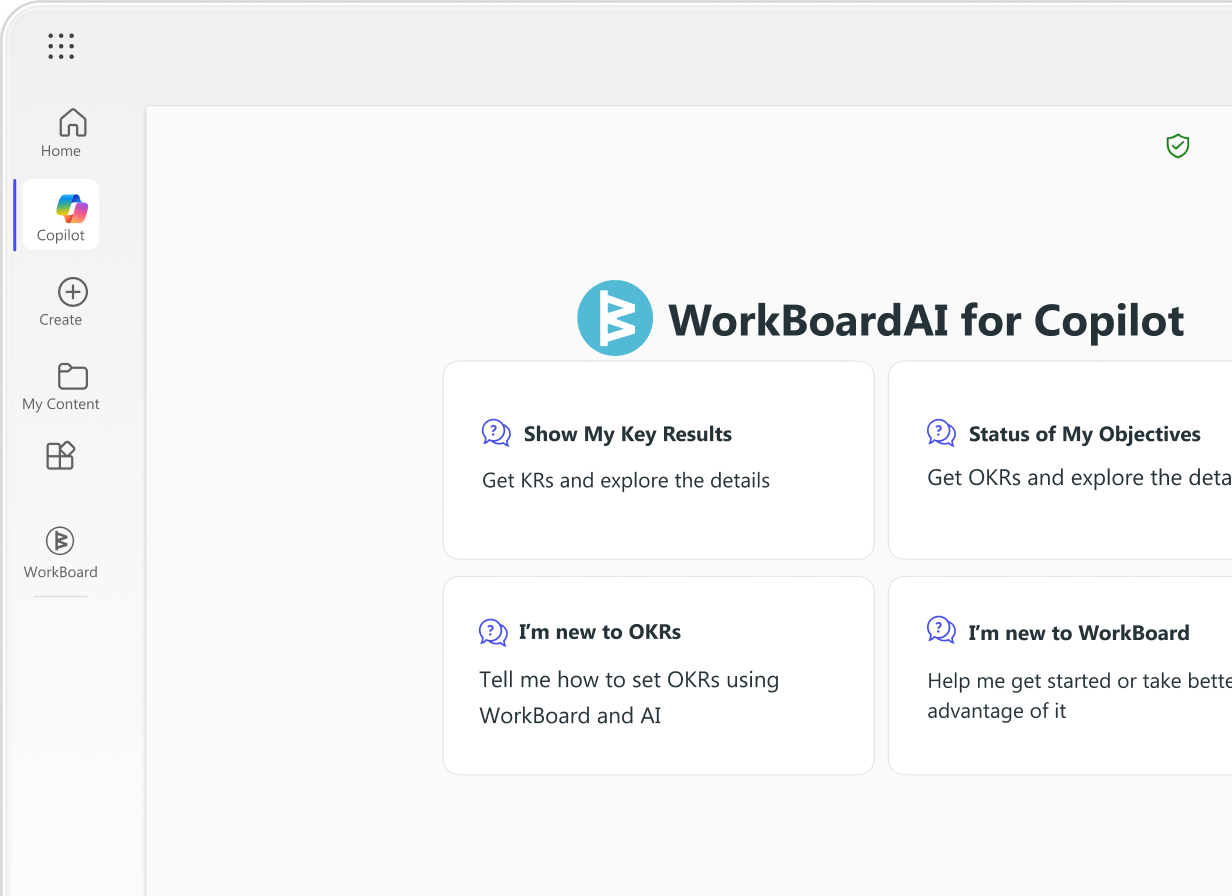
WorkBoardAI is the system that makes this possible at scale with embedded AI agents into the strategy execution system of record. The agents continuously track progress, surface risk, and highlight where focus is drifting, ensuring leaders and teams stay aligned week to week. Strategic intent is translated into execution signals, operating rhythms become engines of accountability, and every conversation is grounded in shared facts. With WorkBoardAI, teams gain earlier insight, stronger alignment, and the confidence to execute with purpose, without relying on manual reporting or status chasing.